Roger Williams was an American journalist who was drafted to serve in the Vietnam War in 1968. Adamantly opposed to the war, he fled to Canada and joined the American Deserters Committee. He wrote articles for the various publications including The New York Times while in exile. He also authored The New Exiles: American War Resisters in Canada. His papers contain his published articles, research files from 1965-1999, correspondence with fellow resisters, photographs, government documents, and a large collection of underground publications and resistance movement ephemera.
Additional content for this collection can be found in the "Inventory for collection."
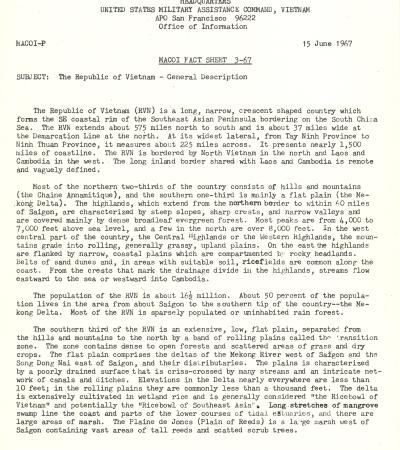
The Republic of Vietnam Fact Sheet, June 15, 1967
This fact sheet, distributed by the Office of Information of the U.S. Military Assistance Command Vietnam, provides basic facts about South Vietnam.
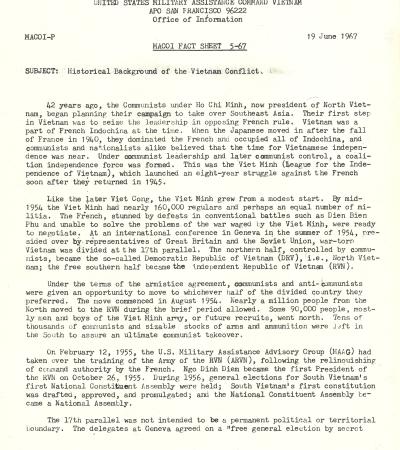
Historical Background of the Vietnam Conflict Fact Sheet, June 19, 1967
This fact sheet, distributed by the Office of Information of the U.S. Military Assistance Command Vietnam, provides historical context for American involvement in the Vietnam War.
Diary of an Infiltrator, October 1967
This document, distributed by the Joint United States Public Affairs Office in Saigon, Vietnam, is a translation of the diary of a North Vietnamese soldier who was sent to fight in South Vietnam. The diary was captured on March 14, 1967 by the U.S. 25th Infantry Division.
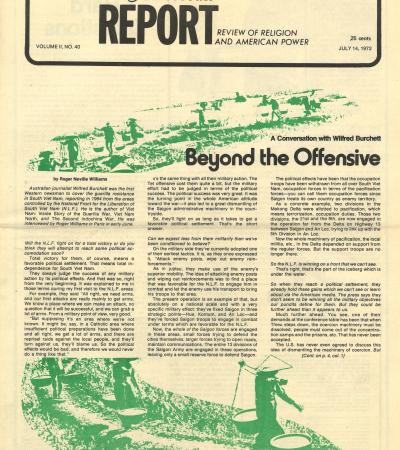
"Beyond the Offensive" by Roger Neville Williams, American Report, July 14, 1972
In this interview, journalist Wilfred Burchett explains that the NLF (National Front for the Liberation of South Vietnam) judged battles by their political impact, not just military results, and believed the Tet Offensive was a turning point because it weakened U.S. support for the war. He argues that despite heavy U.S. bombing and technology, the Viet Cong kept the advantage by gaining support in the countryside. Burchett also notes that as the war had spread across Vietnam, Cambodia, and Laos, peace was now harder to achieve.
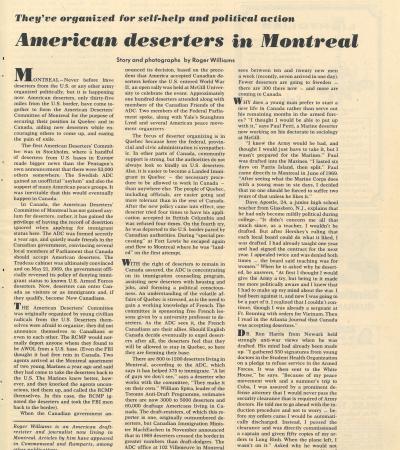
"American Deserters in Montreal" by Roger Williams, Boston Sunday Globe, June 28, 1970
This article explains how American deserters in Montreal, Canada formed the American Deserters’ Committee. The deserters had left the U.S. because of their opposition to the Vietnam War. In the article, many deserters shared personal stories about leaving the U.S. military. The group helped newcomers find housing, jobs, and a sense of community and positioned itself as part of a larger anti-war political movement in exile.
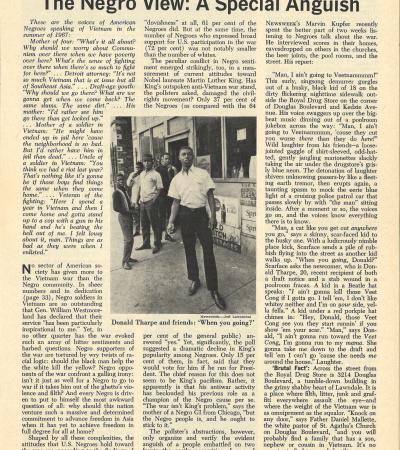
"The Negro View: A Special Anguish", Newsweek, July 10, 1967
The article describes how many Black Americans in the 1960s felt torn about the Vietnam War, since they were drafted in large numbers to fight in Vietnam while still facing racism and poverty at home. Some supported the war to show loyalty, but many others questioned why the U.S. fought for freedom in Southeast Asia.
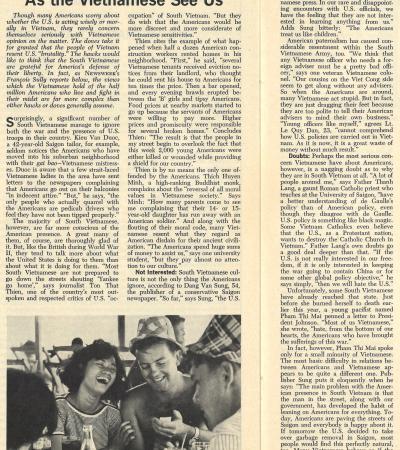
"As the Vietnamese See Us", Newsweek, July 10, 1967
The article explains that while some Vietnamese were thankful for U.S. help against communism, many others resented the American presence in Vietnam. Vietnamese critics said Americans ignored their culture, spent money carelessly, and often treated Vietnam as if it could not function without U.S. military advisers. These mixed feelings created doubt about America’s true intentions.
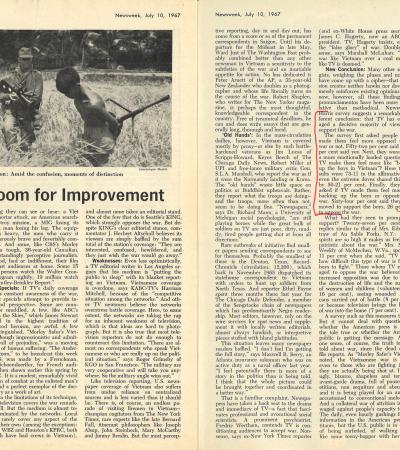
"The Press: Room for Improvement", Newsweek, July 10, 1967
The article explains that during the Vietnam War, U.S. reporters flooded American readers with stories, but their coverage was often criticized for focusing on dramatic images rather than deeper understanding. Television especially was blamed for showing constant violence without context, leaving Americans confused and divided about whether to support or oppose the war.
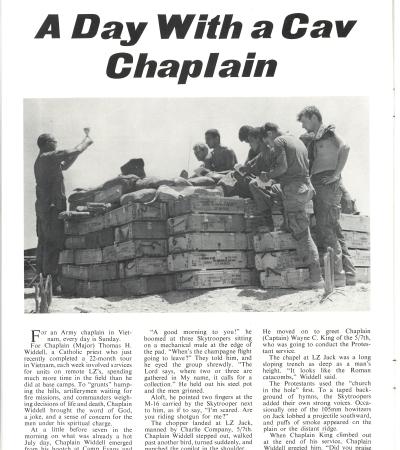
"A Day With a Cav Chaplain", The Air Cavalry Division, September 1968
This magazine article follows Chaplain Major Thomas H. Widdell, a Catholic priest, as he travels across Vietnam to hold church services for soldiers in remote and dangerous locations. He balanced leading Mass with listening to soldiers’ worries, sharing jokes, and offering comfort in the middle of war zones.
Seventh Air Force News Release, December 16, 1968
This news release is representative of those issued daily by the U.S. Air Force during the Vietnam War. It details attacks on enemy locations in South Vietnam. Similar news releases were issued by the U.S. Army and U.S. Navy.
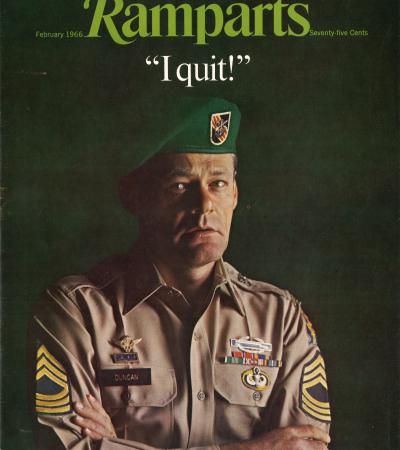
"The Whole Thing Was A Lie!" by Donald Duncan, Ramparts, February 1966
In this article, Duncan an U.S. Army Special Forces Master Sergeant, explains his disillusionment with the Vietnam War. He describes how he once strongly believed in fighting communism but came to see the war as dishonest, filled with corruption, racism, and actions that harmed civilians rather than protecting freedom. Duncan concludes that the U.S. was not bringing democracy to Vietnam but instead spreading destruction, and he supports those who protest the war.
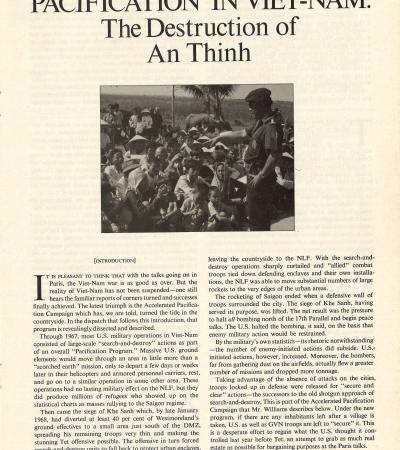
"Pacification In Viet-Nam: The Destruction of An Thinh" by Roger Williams, Ramparts, May 1969
The article describes how the U.S. military’s “pacification” program destroyed the Vietnamese village of An Thinh, which had been peaceful and self-sufficient under Viet Cong control. Soldiers burned homes, bulldozed gardens, and displaced thousands of people, while official reports falsely claimed the area was now “secure” for bargaining in peace talks. Williams argues that these actions caused more harm than stability.
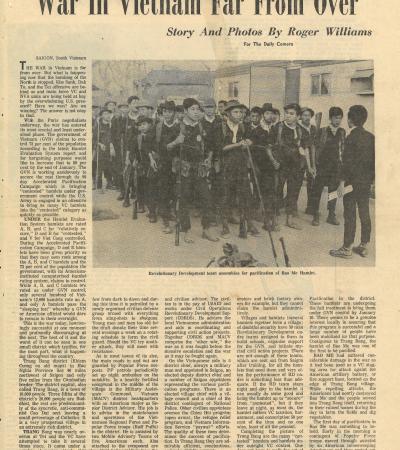
"War In Vietnam Far From Over" by Roger Williams, Focus, June 22, 1969
The article explains that even after big battles like the Tet Offensive and peace talks in Paris, the Vietnam War's outcome was still very uncertain, with South Vietnamese villages constantly shifting between government and Viet Cong control. It describes how some towns, like Bao Me, were pacified with U.S. and South Vietnamese support, while others, like An Thinh, were destroyed in fighting and left in ruins.
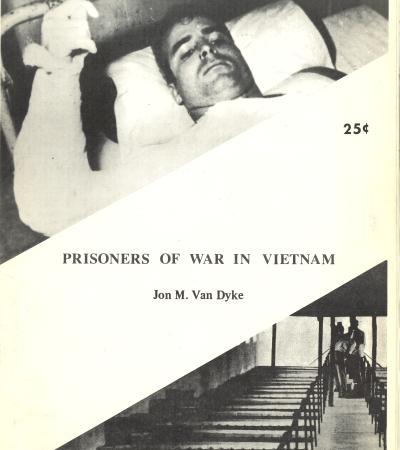
"Prisoners of War in Vietnam" by Jon M. Van Dyke, 1970
Van Dyke's publication examines how both North Vietnam and the U.S.-backed South Vietnamese government treated prisoners during the war. It argues that while the U.S. accused North Vietnam of mistreating American POWs, evidence suggests that South Vietnamese prisons, often supported by the U.S., were equally brutal, with torture and harsh conditions documented in places like the “tiger cages” of Con Son prison. The report concludes that both sides violated international standards, and it calls for updated rules to protect prisoners in modern wars, especially in guerrilla conflicts.
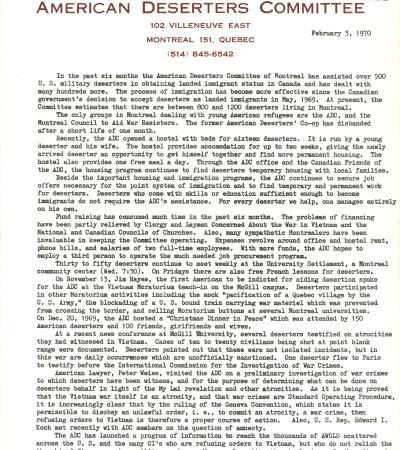
American Deserters Committee Newsletter, February 3, 1970
The American Deserters Committee in Montreal helped hundreds of U.S. soldiers who refused to fight in Vietnam find housing, jobs, and legal status in Canada. They ran a hostel, organized community events, and gave deserters a chance to speak publicly about the atrocities they had seen in Vietnam. The group also pushed for amnesty in the U.S., arguing that refusing to fight in an unjust war should not be punished as a crime.
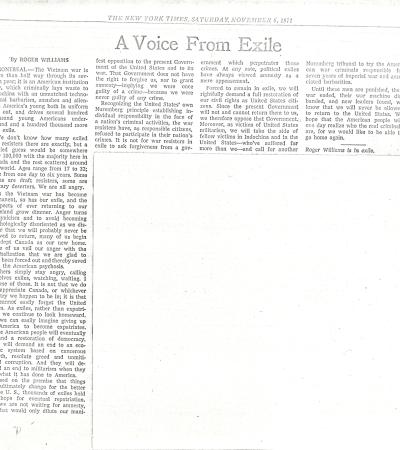
"A Voice From Exile" by Roger Williams, The New York Times, November 6, 1971
Williams, an American living in exile in Canada, writes that many war resisters fled the U.S. during the Vietnam War because they believed fighting was immoral. He argues that they did not want amnesty or forgiveness, since that would mean admitting guilt, but instead demanded an end to the war. Williams says exiles would continue to protest U.S. militarism, support war victims, and fight for justice even though they could not return home.
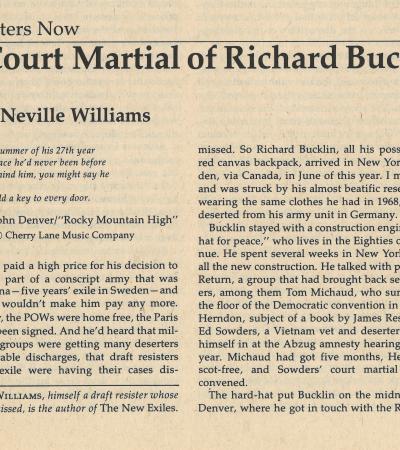
"The Court Martial of Richard Bucklin" by Roger Neville Williams, The New Republic, December 15, 1973
Richard Bucklin deserted the U.S. Army in 1968 because he believed the Vietnam War was wrong. He lived in exile in Sweden for five years before turning himself in, expecting only a discharge. At first the Army seemed ready to release him, but then reversed its decision and put him on trial, charging him with being absent without leave (AWOL). Bucklin’s case became significant because his lawyers argued he was justified in refusing to fight in an illegal war.
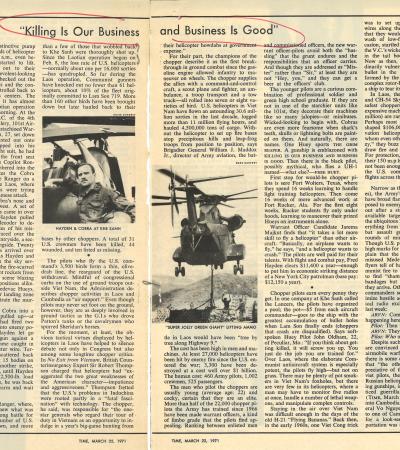
"Killing Is Our Business and Business Is Good", Time, March 22, 1971
The article describes how U.S. helicopter pilots in Vietnam played a major role in the war, flying dangerous missions to attack enemy forces, rescue soldiers, and move supplies. It explains that many pilots faced extreme risks, with helicopters often shot down. The story also highlights the culture among pilots, where courage, competition, and the dangerous nature of their work shaped their lives and the war effort.
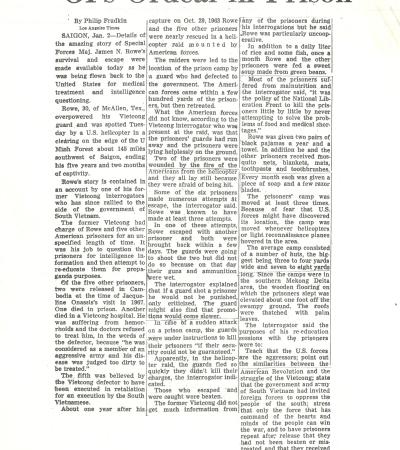
"GI's Ordeal In Prison" by Philip Fradkin, Los Angeles Times
Special Forces Major James N. Rowe spent over five years as a prisoner of war in the Vietnam jungle before he overpowered a guard and was rescued by U.S. forces. During his captivity, he and other prisoners suffered from malnutrition & harsh living conditions. They made repeated escape attempts and were forced to attend “re-education” sessions by their captors.
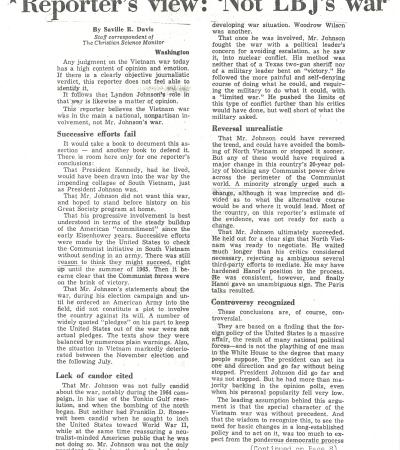
"Reporter's View: 'Not LBJ's War'" by Saville R. Davis, The Christian Science Monitor, January 3, 1969
The article argues that President Lyndon B. Johnson was not the one who started the Vietnam War; instead, he inherited it from earlier presidents who had already committed the U.S. to supporting South Vietnam. It explains that Johnson expanded America’s role because he believed backing out would hurt U.S. credibility and allow communism to spread.
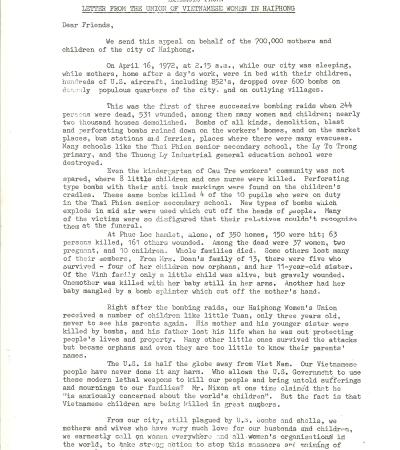
Letter From The Union Of Vietnamese Women In Haiphong, June 27, 1972
This letter describes U.S. bombing raids on the Vietnamese city of Haiphong. The bombings killed hundreds of civilians, including women and children.
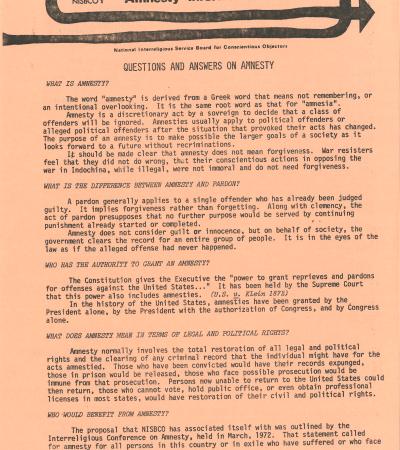
Questions and Answers on Amnesty, April 1973
This series of questions and answers was published by the National Interreligious Service Board for Conscientious Objectors (NISBCO).
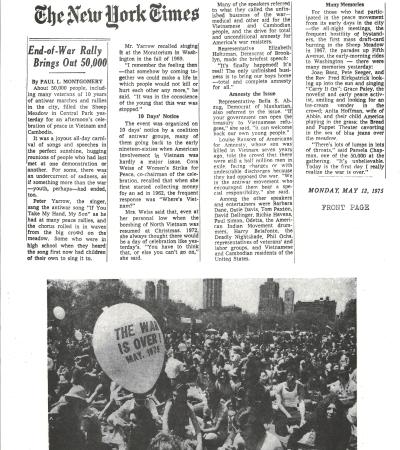
"End-of-War Rally Brings Out 50,000" by Paul L. Montgomery, The New York Times, May 12, 1975
About 50,000 people gathered in Central Park in New York City to celebrate the end of the Vietnam War with songs, speeches, and reunions of antiwar activists. While the mood was joyful, many speakers reminded the crowd that unfinished issues remained, such as unconditional amnesty for war resisters and continued aid for Vietnamese and Cambodian people.
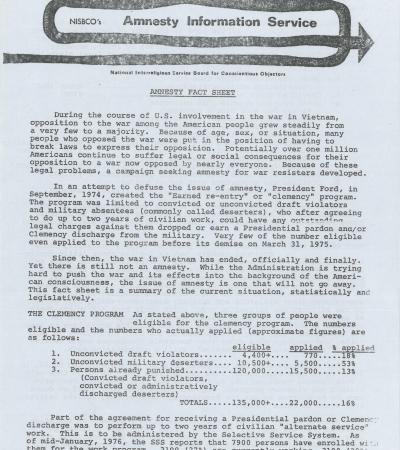
Amnesty Fact Sheet, February 2, 1976
This fact sheet was published by the National Interreligious Service Board for Conscientious Objectors (NISBCO). Despite the official end of U.S. involvement in the Vietnam War, hundreds of thousands of draft violators and military deserters were still being punished. NISBCO argued for an unconditional amnesty program.
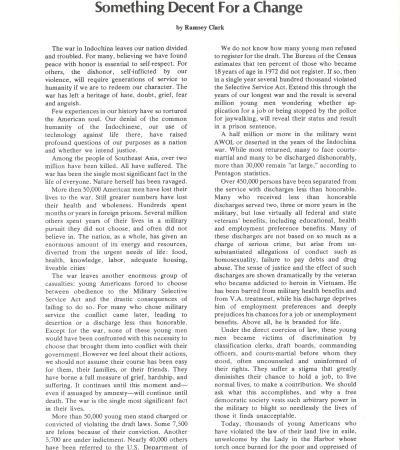
"A Brief For Amnesty: Something Decent For a Change" by Ramsey Clark
This article was written by Clark, who was the U.S. Attorney General under the administration of President Lyndon B. Johnson. In it, Clark points out that the Vietnam War left deep wounds for both Southeast Asians and Americans, including many young men punished for resisting the draft, deserting, or receiving less-than-honorable discharges. Clark explains that these men, along with their families, still suffer from stigma, lost opportunities, and exile. He calls for full and unconditional amnesty.
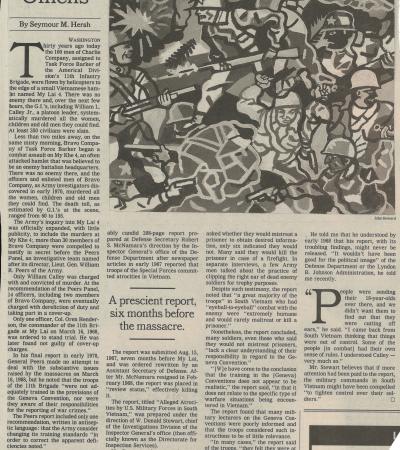
"My Lai, And Its Omens" by Seymour M. Hersh, The New York Times, March 16, 1998
This article was written thirty years after the Vietnam War's My Lai massacre, where American soldiers killed hundreds of Vietnamese civilians. It explains how the massacre was part of a larger problem of misconduct during the war. An earlier Army report had already warned that U.S. troops did not understand or follow the Geneva Conventions, which set rules for the humane treatment of civilians and prisoners.
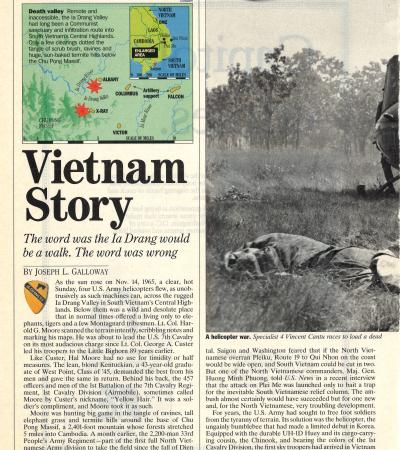
"Vietnam Story" by Joseph L. Galloway, U.S. News & World Report, October 29, 1990
This special report was published 25 years after soldiers of the U.S. 7th Cavalry fought the first major battle of the Vietnam War. It includes an eyewitness account of the fierce 1965 Battle of Ia Drang, the first major clash between U.S. troops and North Vietnamese forces. It explains how U.S. soldiers faced overwhelming enemy numbers in a brutal fight that tested new helicopter-based strategies and cost many lives on both sides. The battle revealed the difficult reality of the Vietnam War.