Veteran journalist and war correspondent Russell Brines (1911-1982) covered major global conflicts for more than four decades, gaining prominence in World War II and the Korean War before covering the Vietnam War from 1965 to 1975 as a freelance correspondent. As an expert on Asian politics and communist expansion, he provided in-depth analysis of the conflict’s broader geopolitical implications. His papers contain government publications, congressional records, documents from both Vietnamese governments, extensive newspaper clippings spanning 1965-1982, magazine articles, protest materials, and photographs from Vietnam.
Additional content for this collection can be found in the "Inventory for collection."
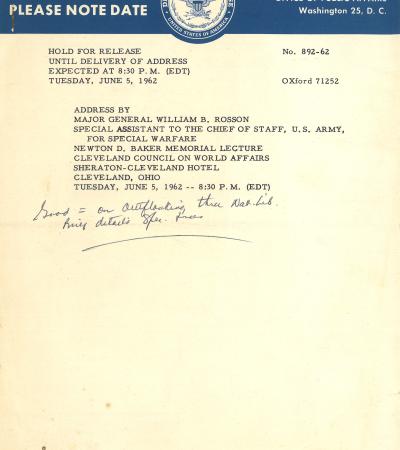
Speech by U.S. Army Major General William B. Rosson, June 5, 1962
Rosson’s speech describes the growing threat of “undeclared wars,” like guerrilla conflicts in Vietnam, as part of a larger global struggle between democracy and communism. He explains that the U.S. must be prepared to counter these smaller, hidden wars with new strategies such as Special Forces, psychological warfare, and nation-building to support friendly governments.
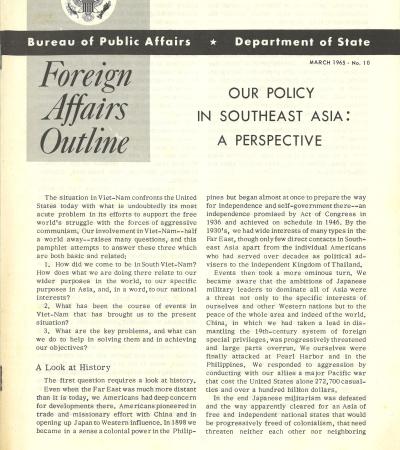
"Our Policy In Southeast Asia: A Perspective", March 1965
This article, published by the U.S. Department of State, explains why America became involved in Vietnam and Southeast Asia. It says the U.S. wanted to stop the spread of communism, help countries become independent, and protect freedom in the region.
Why Vietnam, 1965
This document provides historical perspective on the U.S. involvement in Vietnam, through letters, transcripts of press conferences and statements to the U.S. Congress.
"The Legality of U.S. Participation in the Defense of Viet-Nam", March 1966
This document, published by the U.S. Department of State, explains why the U.S. government believed its involvement in defending South Vietnam during the 1960s was legal. It argues that under international law and the United Nations Charter, the U.S. and South Vietnam had the right to defend themselves against armed attacks from North Vietnam, including infiltration and military aggression.
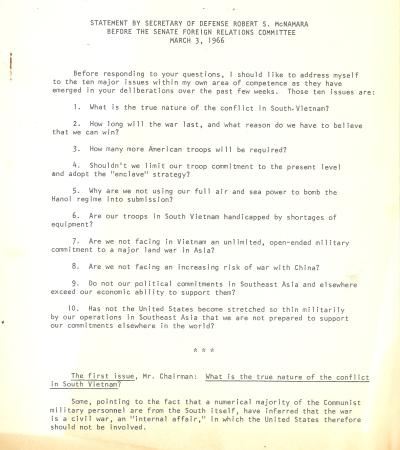
Statement by U.S. Secretary of Defense Robert S. McNamara, March 3, 1966
In McNamara's statement, made before the Senate Foreign Relations Committee, he argues that the conflict in Vietnam was not a civil war but an attack from North Vietnam, and that the U.S. was fighting to help South Vietnam remain independent. McNamara said the U.S. had enough military power to meet its goals without overextending itself and emphasized that the ultimate objective was free elections in South Vietnam.
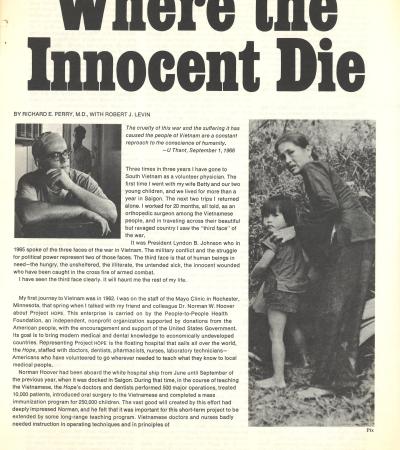
"Where the Innocent Die" by Richard E. Perry, Redbook, January 1967
Perry, who had worked in Vietnam as a volunteer physician, writes about the terrible suffering of civilians caught in the war. He saw hospitals with almost no resources, and children and families injured by bombs, landmines, and napalm. He argues America has a responsibility to help the innocent victims by providing medical aid and rebuilding the country after the fighting ends.
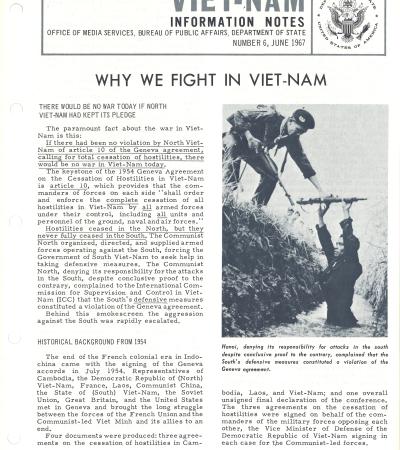
"Why We Fight In Viet-Nam"
This document was published by the U.S. Department of State. It argues that the Vietnam War happened because North Vietnam broke the Geneva Agreement by continuing to support attacks in the South after 1954. It explains that America joined the fight not only to keep its promise to South Vietnam, but also to stop the spread of communism, protect important areas in Asia, and defend the right of nations to decide their own futures without violence.
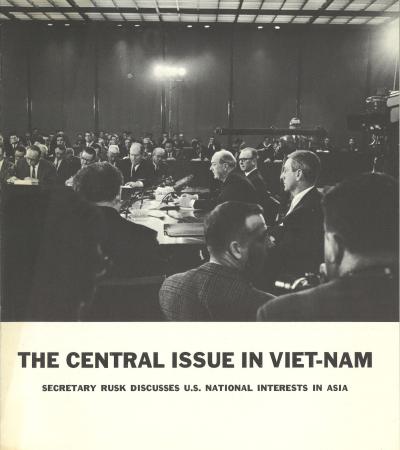
"The Central Issue In Viet-Nam", October 12, 1967
This document is the transcript of U.S. Secretary of State Dean Rusk's news conference on Vietnam. Rusk explained that the U.S. was committed to supporting its allies in Southeast Asia to stop the spread of communism, but stressed that the goal was limited—seeking peace without escalating into a larger war. Rusk also emphasized that the U.S. was open to negotiations at any time, but said that North Vietnam’s refusal to discuss peace showed they still hoped to win through force.
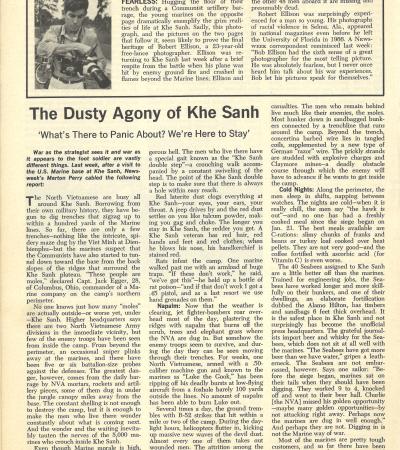
"The Dusty Agony of Khe Sanh", Newsweek, March 18, 1968
The article describes the harsh life of U.S. Marines trapped in the Khe Sanh base during constant attacks by North Vietnamese forces. The soldiers lived in dangerous, dusty, and uncomfortable conditions, facing daily artillery fire, food shortages, rats, and cold nights, while relying on bunkers and trenches for safety. Despite the misery, the Marines stayed confident in their strength and air power.
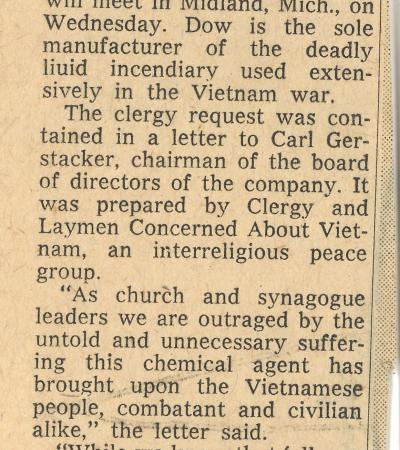
"Clergy Ask Dow For Napalm Vote", May 5, 1968
Religious leaders from American Protestant, Catholic, and Jewish groups asked the Dow Chemical Company to let stockholders vote on whether to keep selling napalm for use in war. They argued that napalm caused extreme and unnecessary suffering for both soldiers and civilians in Vietnam, leaving survivors with terrible burns and scars.
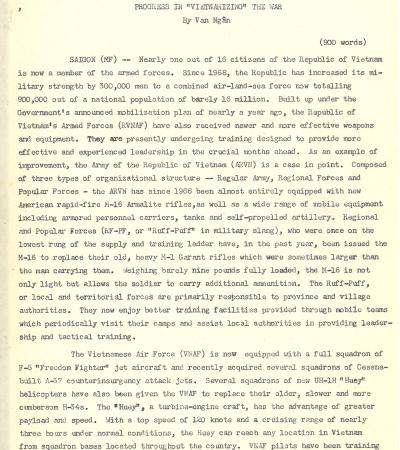
"Progress In 'Vietnamizing' The War" by Van Ngân
This news release, from a South Vietnamese author, describes the progress of South Vietnam’s armed forces during the Vietnam War. By 1970, their army, navy, and air force had grown stronger with better weapons, U.S. supplied modern equipment like M-16 rifles and Huey helicopters, and more training to help them fight independently.
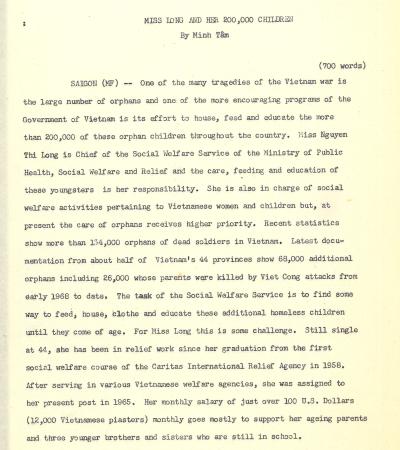
"Miss Long And Her 200,000 Children" by Minh Tâm
This article, written by a South Vietnamese author, tells the story of Miss Nguyen Thi Long, who is responsible for helping more than 200,000 orphans in Vietnam during the war. She oversees government and private orphanages, adoption programs, and schools, but explains that only a small fraction of the children can be cared for properly. Miss Long partners with international groups like UNICEF to provide aid to the children.
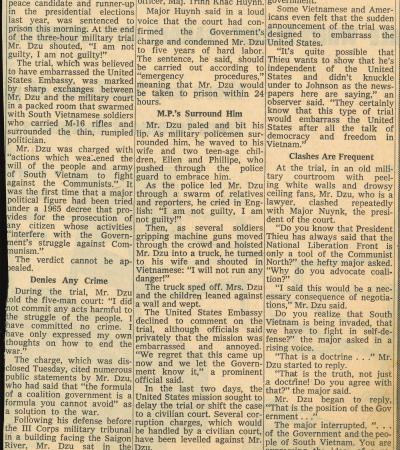
"Saigon Is Expected to Send Dzu to Prison Island" by Bernard Weinraub, The New York Times, July 27, 1968
Truong Dinh Dzu, who had recently run for president of South Vietnam, was sentenced to five years of hard labor for suggesting peace talks with the Vietcong. At his trial, Dzu declared his innocence, saying he had only shared ideas on ending the war, but the court ruled that his statements hurt the government’s fight against communism.
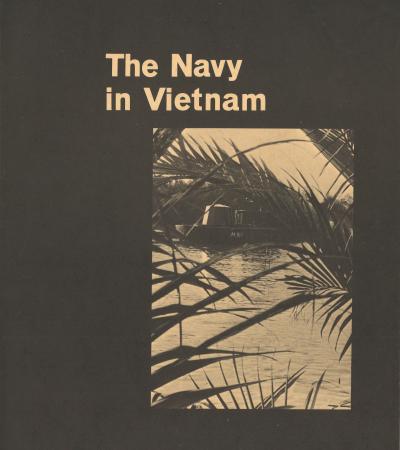
The Navy in Vietnam, 1968
This booklet explains the many roles of the U.S. Navy during the Vietnam War. Navy forces carried out missions like stopping enemy supplies at sea, patrolling rivers with small boats, and supporting joint Army-Navy river attacks. In addition to combat, the Navy helped build bases, provided medical aid, and worked with Vietnamese forces to improve their navy.
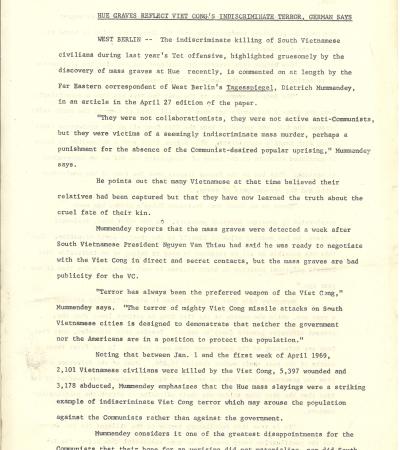
"Hue Graves Reflect Viet Cong's Indiscriminate Terror, German Says", May 3, 1969
This article explains how mass graves found in Hue revealed the killing of many South Vietnamese civilians during the Tet Offensive. The Viet Cong were notorious for their use of terror tactics against civilian populations. The reporter notes that while the Viet Cong hoped the offensive would spark uprisings and mass defections, this largely did not happen, and instead the violence may have turned people against the Viet Cong.
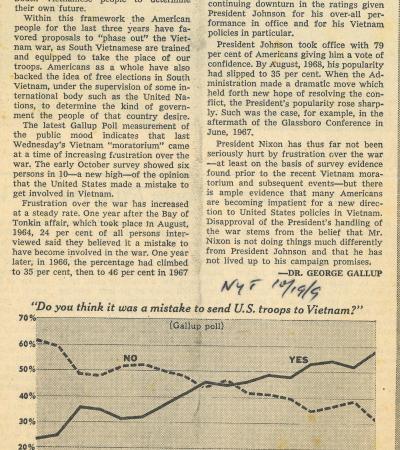
"Gallup Finds Increasing Frustration Over War", The New York Times, October 19, 1969
A Gallup Poll showed that by 1969, more and more Americans believed it was a mistake to send U.S. troops to Vietnam, with about 6 in 10 people holding this view. Public frustration had grown steadily since 1964, increasing as U.S. casualties rose and confidence in government leaders fell. Many Americans were impatient for a new direction and felt President Nixon was not doing enough to change U.S. policy in Vietnam.
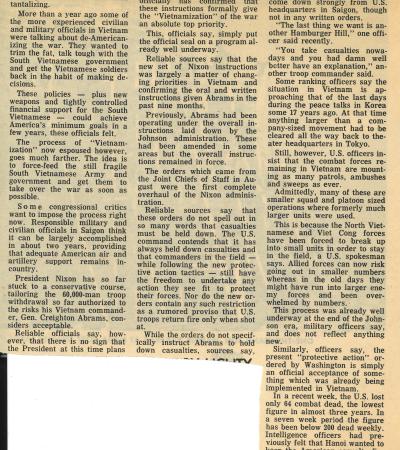
"Casualties Go Down, 'Vietnamization' is Up" by George McArthur, Pacific Stars & Stripes, October 20, 1969
The article explains that U.S. combat deaths in Vietnam were decreasing in 1969 as the U.S. shifted responsibility for fighting to the South Vietnamese military, a process called “Vietnamization”. President Nixon and military leaders wanted American troops to focus more on protective actions while South Vietnamese forces took on a bigger role.
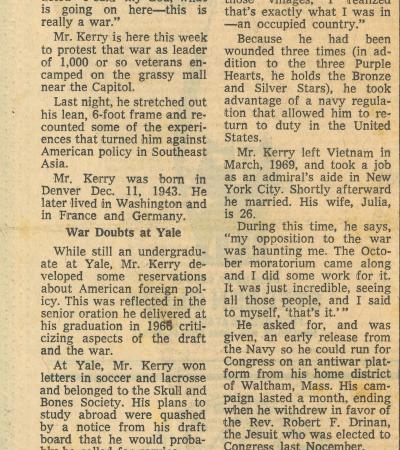
"Angry War Veteran", April 23, 1971
This article tells the story of John Kerry, a Vietnam War veteran who grew disillusioned with the war after his experiences as a Navy officer. Though he first believed strongly in serving his country, the violence he witnessed in Vietnam led him to protest U.S. involvement alongside thousands of other veterans. Kerry eventually went on to become a U.S. Senator and Secretary of State.
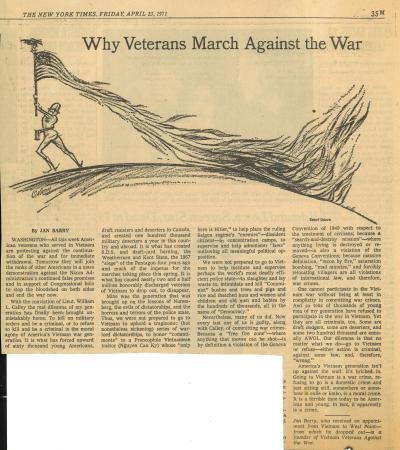
"Why Veterans March Against the War" by Jan Barry, The New York Times, April 23, 1971
This article explains why many Vietnam veterans protested the war in 1971, saying they were tired of false promises and wanted the fighting to end immediately. The veterans described how their generation was forced to fight in a war filled with violence, destruction, and moral contradictions, which left many feeling guilty or disillusioned.
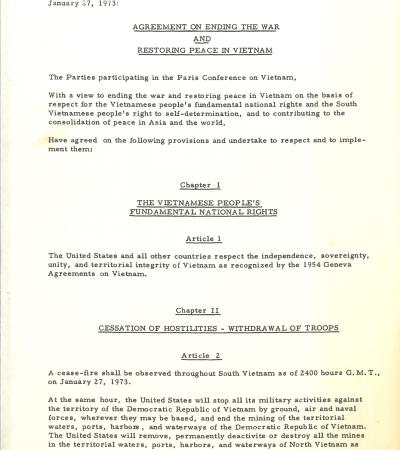
Paris Peace Accords Press Release - Agreement On Ending The War And Restoring Peace In Vietnam, January 24, 1973
The end to U.S. involvement in the Vietnam War was formally agreed to on January 27, 1973 in Paris, France. This is a copy of some of the documents signed on that day, concerning cessation of hostilities and withdrawal of troops.
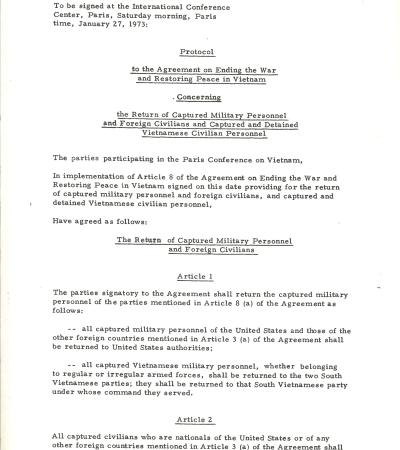
Paris Peace Accords Press Release - Concerning the Return of Captured Military Personnel, January 24, 1973
The end to U.S. involvement in the Vietnam War was formally agreed to on January 27, 1973 in Paris, France. This is a copy of some of the documents signed on that day, concerning the return of captured military personnel.