U.S. Information Agency officer Lloyd Burlingham (1911-1988) served in Southeast Asia during the Cold War era, working in Thailand, Buenos Aires, and Saigon as director of public information for the Southeast Asia Treaty Organization (SEATO) from 1961 to 1965. Born in Manila and educated at the University of Rochester and Columbia University's Russian Institute, he joined the U.S. Information Service in 1957. His papers contain Vietnam War materials including reports, press releases, analysis, interviews, maps, news clippings spanning 1955-1972, SEATO records, and propaganda materials used against the U.S. in Southeast Asia.
Additional content for this collection can be found in the "Inventory for collection."
Dr. Le Vinh Can Transcript, March 19, 1968
Dr. Le Vinh Can, a North Vietnamese Army surgeon, describes his defection to South Vietnam after becoming disillusioned with the communist government’s harsh control and poor living conditions. He explains that many wounded soldiers in his North Vietnamese medical unit died from shortages of medicine, blood, and supplies, and that evacuation of the injured was often delayed for days, making treatment nearly impossible.
Interview Concerning the National Liberation Front of South Vietnam, June 3, 1968
In this transcript of an interview with a South Vietnamese high school teacher, he discusses the halt of U.S. bombing on North Vietnam. He argues that while America claimed to act out of “good will toward peace,” the decision hurt South Vietnam militarily and politically by allowing North Vietnam to rebuild, strengthen its forces, and gain propaganda advantages.
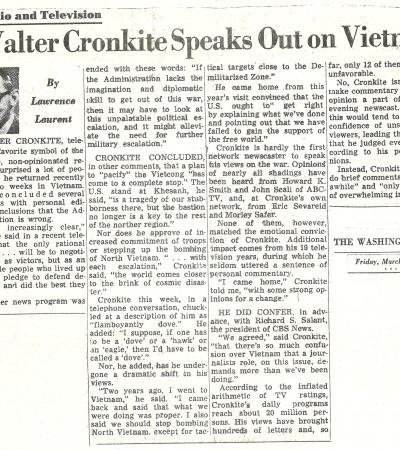
"Walter Cronkite Speaks Out On Vietnam" by Lawrence Laurent, The Washington Post, March 8, 1968
Television journalist Walter Cronkite, known for his neutral reporting of the news, shared his personal view that the Vietnam War could not be won militarily and should end through negotiations. After visiting Vietnam, Cronkite came to the conclusion that continued bombing and escalation would only bring the world closer to disaster.
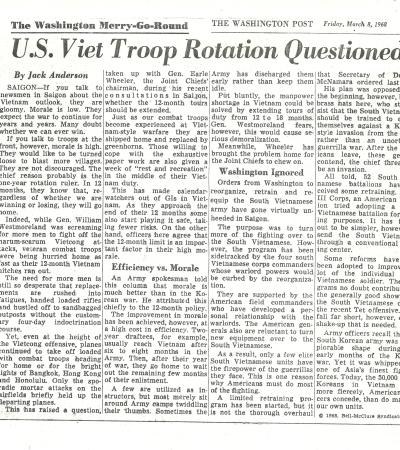
"U.S. Viet Troop Rotation Questioned" by Jack Anderson, The Washington Post, March 8, 1968
This article discusses the U.S. military's one-year rotation policy that sent experienced troops home from Vietnam just as they adjusted to combat. Commanders worried that constantly replacing soldiers with inexperienced ones hurt morale and effectiveness.
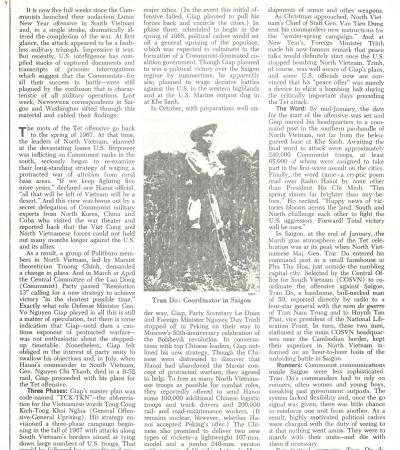
"The TET Offensive: How They Did It", Newsweek, March, 1968
The article explains how North Vietnam planned and carried out the 1968 Tet Offensive, a surprise attack that changed the course of the Vietnam War. It describes how General Giap organized the offensive in secret, dividing Saigon into attack zones and using deception and hidden weapons to prepare for the assault. The attack shocked the U.S. and South Vietnam, proving the enemy’s strength and shaking American confidence in the war’s success.
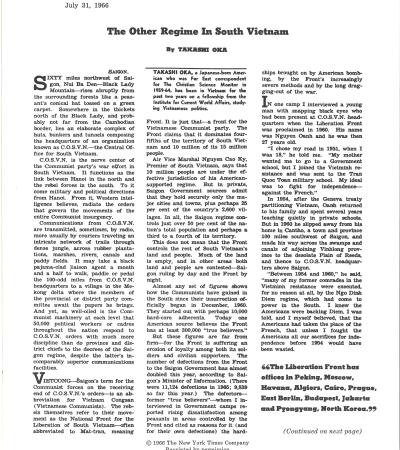
"The Other Regime In South Vietnam" by Takashi Oka, The New York Times Magazine, July 31, 1966
The article explains that the Communist-led National Liberation Front (NLF), directed by the Central Office for South Vietnam (C.O.S.V.N.), was a highly organized force that controlled much of the countryside and rivaled the South Vietnamese government’s authority. Through the story of defectors like Nguyen Oanh, the article shows that the Vietcong’s early ideals of independence and discipline gradually eroded due to harsh conditions, U.S. bombings, and internal corruption.
"Portrait Of Life With The Vietcong - A Defector's Story" by Seymour Topping, The New York Times, May 23, 1965
The article tells the story of Do Van Dau, a former Vietcong officer who defected to the South Vietnamese government. Dau describes his life from joining the Communist forces at age fifteen, serving in North Vietnam and Laos, and returning south to fight in brutal guerrilla battles. Eventually, disillusioned by corruption, hunger, and the killing of his mother, he escaped, explaining that although he had abandoned Communism, he still felt caught between two worlds.
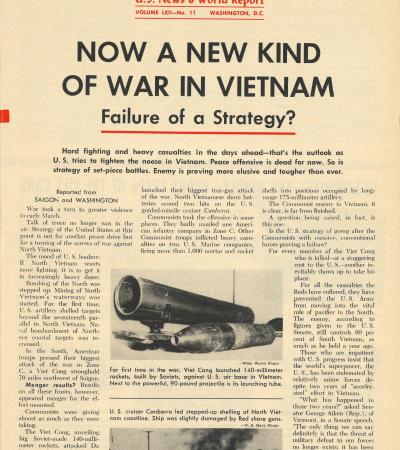
"Now A New Kind Of War In Vietnam", U.S. News & World Report, March 13, 1967
This article explains how the Vietnam War had entered a deadlier and more frustrating stage for U.S. forces. It describes how, despite massive bombing, advanced weapons, and more troops, the Viet Cong continued to resist through guerrilla tactics, traps, and ambushes that caused heavy American casualties.
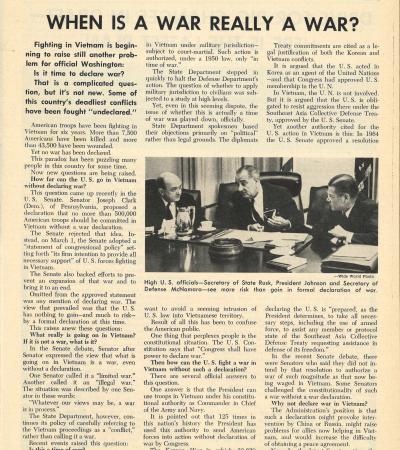
"When Is A War Really A War?", U.S. News & World Report, March 13, 1967
This article explains the debate in Washington over whether the Vietnam conflict should be formally declared a war. It describes how U.S. leaders avoided calling it a war for political and legal reasons, even though thousands of Americans were fighting and dying there. Lawmakers argued that a formal declaration might make the situation worse internationally, so they continued to treat Vietnam as an “undeclared war.”
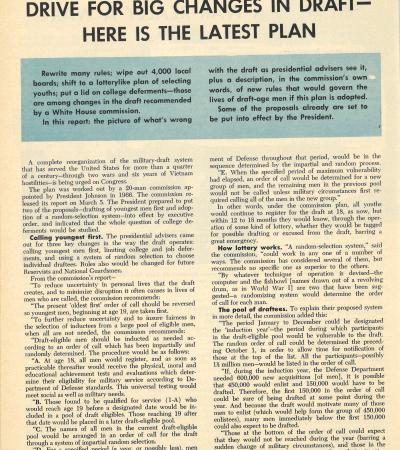
"Drive For Big Changes In Draft - Here Is The Latest Plan", U.S. News & World Report, March 13, 1967
The article explains that a White House commission proposed major reforms to the military draft system during the Vietnam War. The plan suggested replacing local draft boards with regional offices, creating a lottery system to randomly select young men for service, and limiting college and job deferments to make the process fairer and more predictable.
Speech by Dr. Ton That Thien, November 27, 1968
Dr. Ton That Thien delivered this address at the Vietnam Council on Foreign Relations. In it, he explained that the future of U.S.–Vietnamese relations depended on both nations understanding each other’s psychology rather than just politics. He said that Vietnamese people value survival, independence, and dignity above all else, even preferring war with suffering to peace without hope.
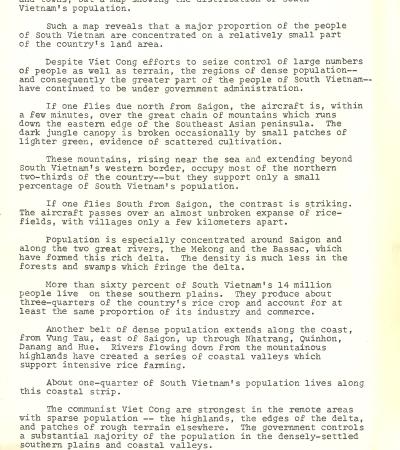
"The Struggle For Control Of South Vietnam's Population" by Frank Sawyer, September 7, 1965
The article explains that the real fight in Vietnam was over control of the people rather than just land. It describes how most of South Vietnam’s population lived in the southern plains and coastal areas, which remained mostly under government control, while the Viet Cong held sparsely populated regions like the highlands. Despite gaining some territory, the Viet Cong had, as of the time the article was written, failed to capture large towns or dense population centers.
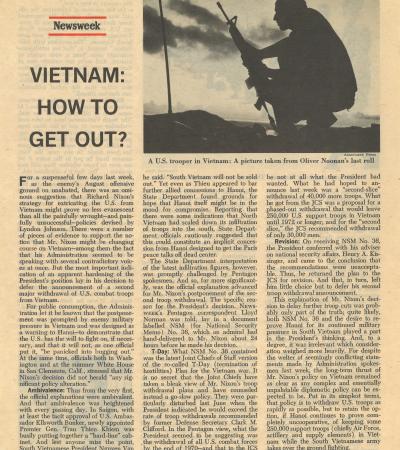
"Vietnam: How To Get Out", Newsweek, September 8, 1969
This article discusses President Nixon’s difficulties in creating a clear plan to withdraw American troops from Vietnam while maintaining U.S. credibility. It also highlights the "Alpha Incident" in which U.S. troops in Vietnman refused to follow orders into battle.
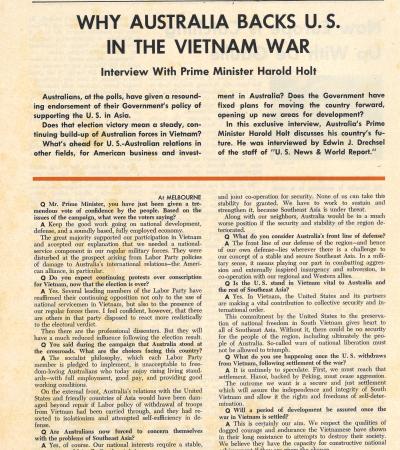
"Why Australia Backs U.S. In The Vietnam War", U.S. News & World Report, January 2, 1967
This magazine article covers an interview with Australian Prime Minister Harold Holt who explains why Australia supports the United States in the Vietnam War. Holt says that Australia’s safety depends on keeping Southeast Asia stable and that the U.S. fight in Vietnam helps protect freedom throughout the region.