South Vietnamese military officer and politician Nguyễn Cao Kỳ (1930-2011) commanded the Republic of Vietnam Air Force and participated in the 1963 coup that overthrew Ngo Dinh Diem. He served as prime minister (1965) and vice president (1967-1971), but was marginalized by President Nguyễn Văn Thiệu’s consolidation of power and withdrew from politics when prevented from running in 1971. He escaped during the fall of Saigon in 1975 and settled in California. His papers include correspondence, manuscripts, photographs, recordings, transcripts, and other materials documenting his role in South Vietnamese politics and military leadership.
Additional content for this collection can be found in the "Inventory for collection."
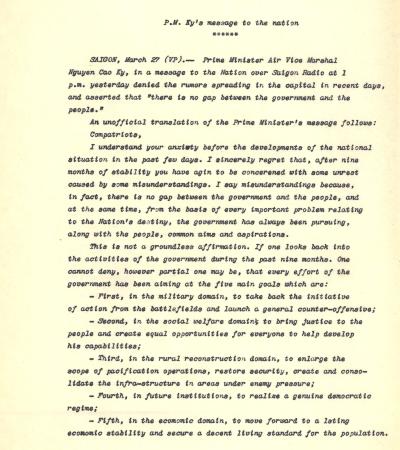
Prime Minister Nguyễn Cao Kỳ's Message To The Nation Of South Vietnam, March 26, 1966
This is the text of the speech given by Kỳ over Saigon Radio. Kỳ addressed a nation that, in addition to being at war, was roiled by turmoil led by Buddhist monks, students, and even some military units who were protesting Kỳ's dismissal of General Nguyễn Chánh Thi. Kỳ' tried to reassure the South Vietnamese people that his administration shared their goals for peace, stability, and progress.
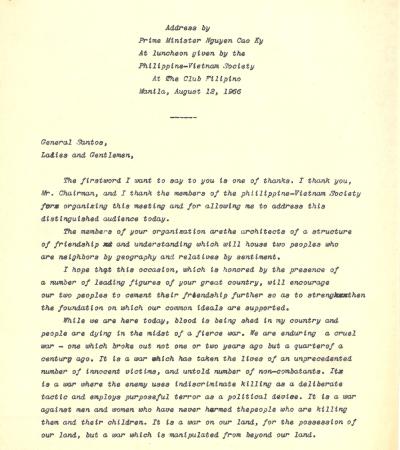
Address by Nguyễn Cao Kỳ, Prime Minister of South Vietnam, To The Philippine-Vietnam Society, August 12, 1966
Kỳ's speech calls for unity among Asian nations to fight aggression and support peace. He argues that South Vietnam’s battle was not just a local conflict but part of a global struggle against communist ideology, and that victory requires both military strength and social reform to eliminate poverty, corruption, and injustice.
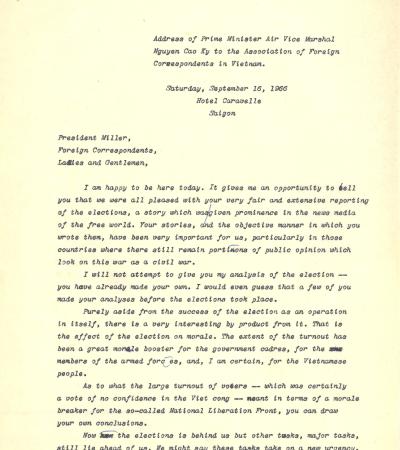
Address of Nguyễn Cao Kỳ, Prime Minister of South Vietnam, To The Association Of Foreign Correspondents In Vietnam, September 16, 1966
In his speech Kỳ thanks journalists for their reporting of South Vietnam’s recent elections and describes them as a morale boost for both the people and the military. He outlines the government’s progress on three major goals: improving rural security, stabilizing the economy, and building democracy through a new constitution and elected government. Kỳ concludes by expressing confidence that South Vietnam would achieve both political and military victories.
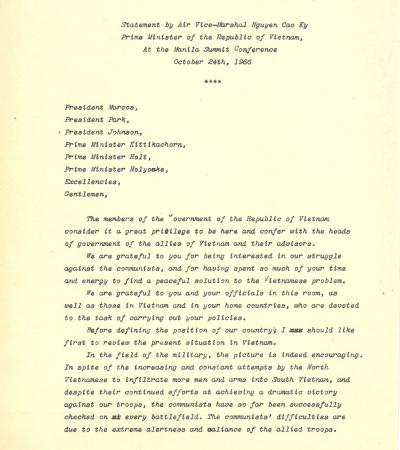
Statement by Nguyễn Cao Kỳ, Prime Minister of South Vietnam, At The Manila Summit Conference, October 24, 1966
This speech was delivered at a summit on the military and political situation in Vietnam and the path to peace. The summit was held in the Philippines and was attended by U.S. President Lyndon B. Johnson and leaders from the Philippines, South Korea, Thailand, Australia, New Zealand and South Vietnam.
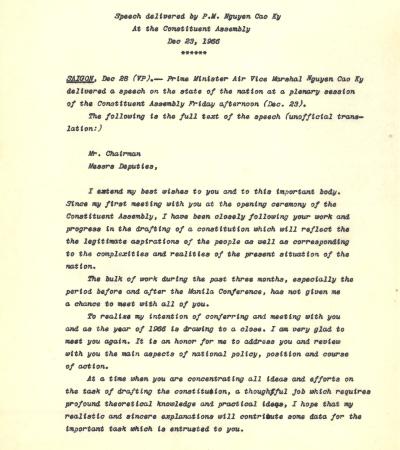
Speech by Prime Minister of South Vietnam Nguyễn Cao Kỳ At The Constituent Assembly, December 23, 1966
Kỳ's speech reviews South Vietnam’s situation during the war and outlines his government’s key policies. He describes the continuing struggle against Communist forces, and efforts to strengthen the military, economy, and society through rural pacification, education, and land reform. Kỳ emphasizes national unity, discipline, and democracy as the foundations for defeating Communism and building a peaceful, independent South Vietnam.
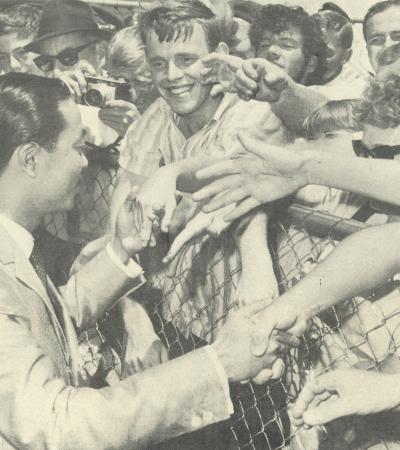
Photograph of South Vietnamese Prime Minister Nguyễn Cao Kỳ greeting an Australian crowd, January 1967
South Vietnamese Prime Minister Nguyễn Cao Kỳ shakes hands with some of the more than 300 Australians who greeted him in Brisbane, Australia. Kỳ traveled to Australia seeking to bolster Australia's continued support for the Vietnam War.
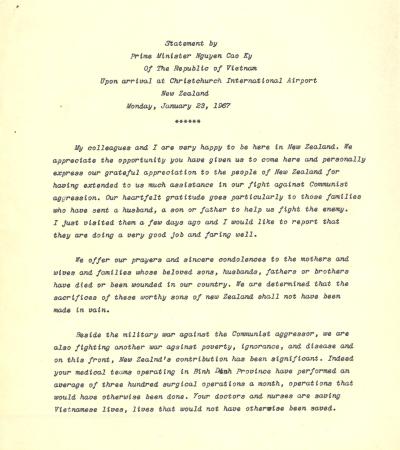
Statement by Nguyễn Cao Kỳ, Prime Minister of South Vietnam, At Christchurch, New Zealand Airport, January 23, 1967
Kỳ's remarks upon arrival in New Zealand praise New Zealand's combat troops and medical support personnel serving in Vietnam.
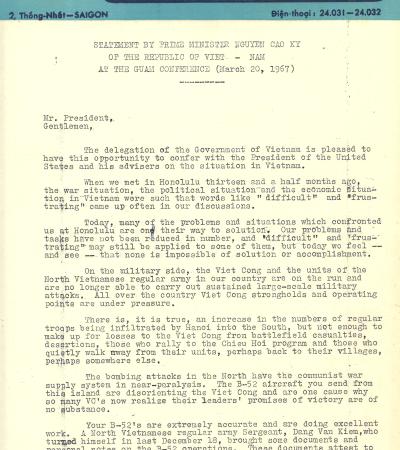
Statement by South Vietnamese Prime Minister Nguyễn Cao Kỳ At The Guam Conference, March 20, 1967
These remarks, delivered at the Guam Conference on Vietnam, addressed U.S. President Lyndon B. Johnson and American government and military officials. In his speech, Kỳ highlights progress in South Vietnam’s fight against the Viet Cong and the country’s move toward democracy. He praises U.S. air support, especially B-52 bombings, and details programs like land reform and the “Chieu Hoi” initiative which offered amnesty and reintegration to former Viet Cong soldiers.
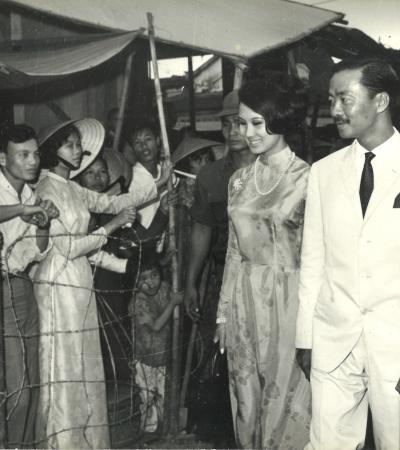
Photograph of South Vietnamese Prime Minister Nguyễn Cao Kỳ and his wife
Kỳ and his wife are shown walking in front of a crowd through the Dong Ba Hue Market in South Vietnam.
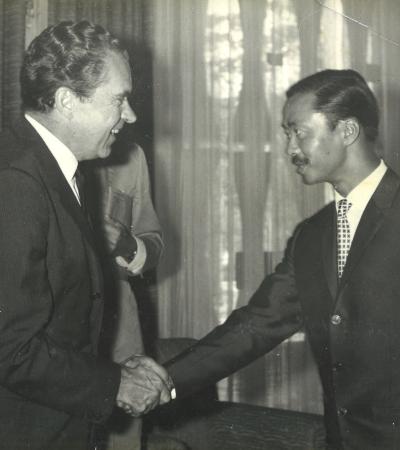
Photograph of South Vietnamese Prime Minister Nguyễn Cao Kỳ and Richard Nixon, April 15, 1967
Kỳ and Nixon are shown shaking hands. At the time, Nixon was a former U.S. vice president and had not yet announced his intention to run for U.S. president in the 1968 election.
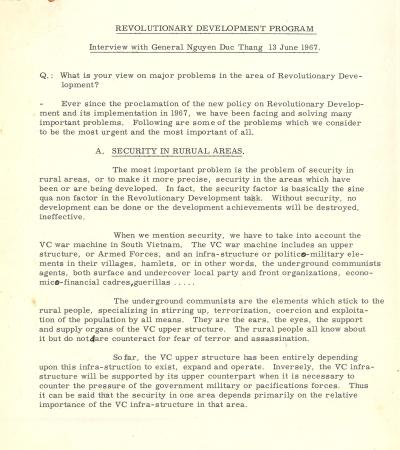
Interview With General Nguyễn Đức Thắng, June 13, 1967
The interview discusses South Vietnam’s Revolutionary Development Program, which aimed to strengthen rural security and win over villagers during the Vietnam War. General Thắng explained that success depended on destroying the Viet Cong’s underground networks, building honest local governments, and empowering villagers to defend themselves.