U.S. Army lawyer Larry Williams (1923-1999) retired as a major general and assistant judge advocate general of the Army in 1979 after serving in various capacities within the Judge Advocate General’s Corps, including assignments in Panama, Germany, and Vietnam. A World War II combat aviator who participated in D-Day airborne operations, Williams later earned law degrees before returning to military service in 1949. His papers contain correspondence, memorandums, and resumes related to Vietnamese personnel who had worked in the Military Assistance Command Legal Office and later immigrated to the United States.
Additional content for this collection can be found in the "Inventory for collection."
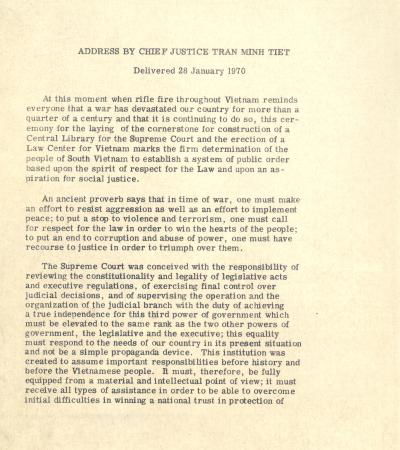
Address by Chief Justice Tran Minh Tiet, January 28, 1970
South Vietnamese Chief Justice Tran Minh Tiet’s 1970 speech emphasizes South Vietnam’s determination to build a strong, independent justice system even amid ongoing war. He explains that creating a well-equipped Supreme Court and a central law library is vital for ensuring fairness, reducing corruption, and protecting citizens’ rights through respect for the law.
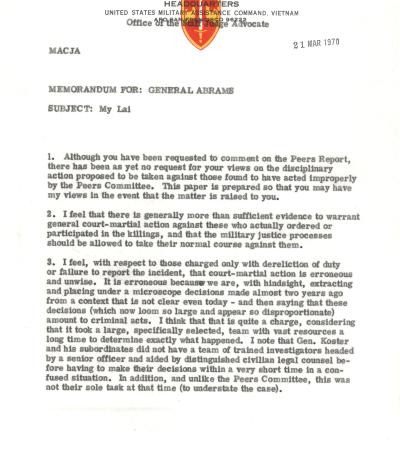
Memo from Lawrence H. Williams to General Abrams, March 21, 1970
This memorandum from Army lawyer Williams to General Abrams discusses how the Army should handle those involved in the My Lai Massacre in Vietnam. Williams recommends that soldiers who directly participated in the killings face court-martial, but he advises against trying officers accused only of failing to report the incident, saying it would be unfair and damaging to morale. He argues that administrative actions and reprimands would be sufficient, warning that further prosecutions could harm the Army’s reputation.
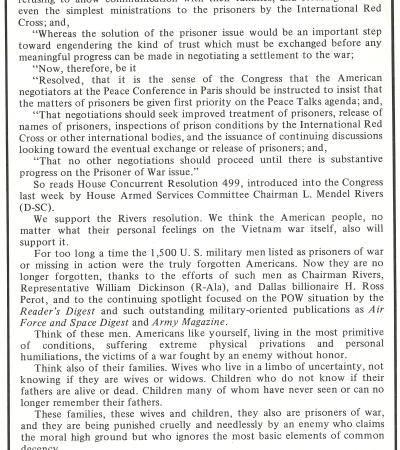
"A Sense of Humanity" by James D. Hessman, Armed Forces Journal, February 14, 1970
This magazine editorial argues that North Vietnam’s treatment of American prisoners of war violates basic human rights and international law. It supports a U.S. congressional resolution urging peace negotiators to prioritize the humane treatment and release of prisoners during the Vietnam War talks.
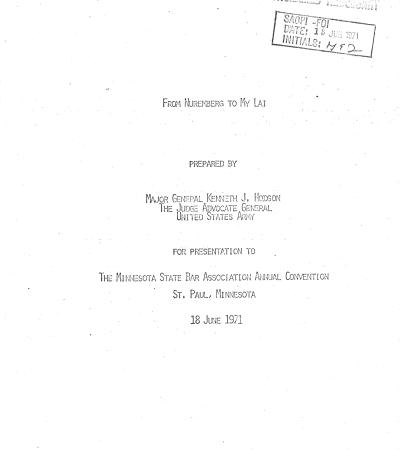
"From Nuremberg To My Lai" by Kenneth J. Hodson, June 18, 1971
The text of this speech explains how the rules of war developed from early times to modern international law, emphasizing accountability for war crimes. He traces how military justice evolved through events like the Nuremberg Trials and argues that following illegal orders cannot excuse crimes, even in difficult conflicts such as Vietnam.
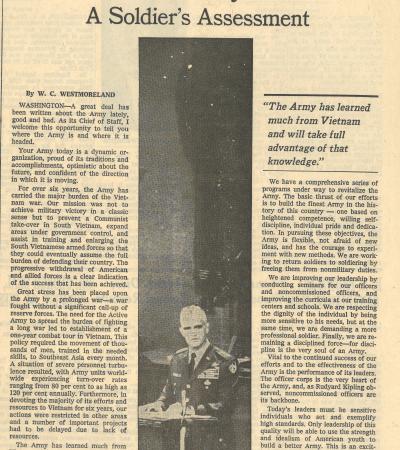
"The Army: A Soldier's Assessment" by W.C. Westmoreland, The New York Times, January 5, 1972
General Westmoreland, who was the commander of the U.S. forces in Vietnam, explains that the U.S. Army has learned valuable lessons from the Vietnam War and is using that experience to strengthen and modernize itself.
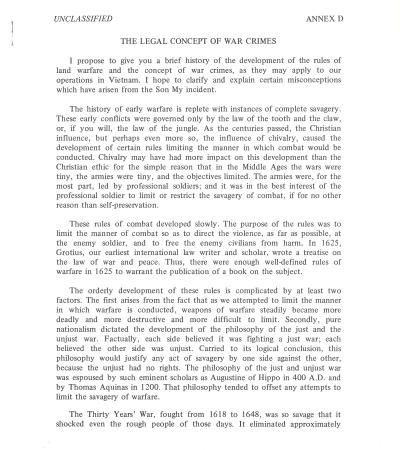
"The Legal Concept Of War Crimes"
This document explains the historical development and modern understanding of war crimes, focusing on how laws of warfare evolved to limit unnecessary suffering and protect civilians. It reviews historical examples—showing how accountability for atrocities shifted from nations to individual soldiers and commanders. The text emphasizes that military leaders must act responsibly to prevent and investigate war crimes, even amid the challenges of modern conflicts like Vietnam.