Johanna Gostas was the Wyoming coordinator of the National League of Prisoners of War/Missing in Action (POW/MIA) Families while her husband, U.S. Army Major Theodore W. Gostas, was held prisoner by the North Vietnamese from 1968 to 1973. She organized letter writing, petition signing and phone calling campaigns and served as a National League representative to a 1971 Geneva conference on prisoner treatment. The collection contains correspondence, news releases, pamphlets, newspaper clippings, materials from the Geneva conference, and an oral history interview with Ted Gostas regarding his experiences as a POW.
Additional content for this collection can be found in the "Inventory for collection."
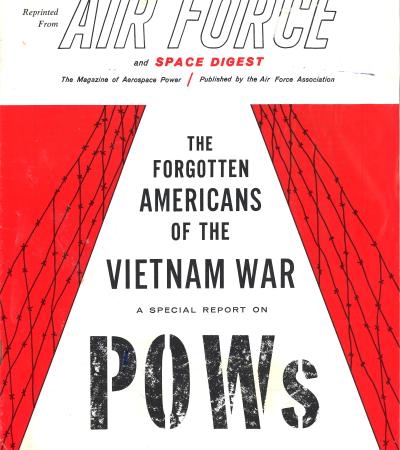
Air Force and Space Digest, October 1969
This issue of the magazine of the Air Force Association describes the suffering of American prisoners of war and missing men in Vietnam, who faced torture, inadequate food, and limited ability to write letters to their families. The article urges Americans to speak out, write letters, and pressure leaders and foreign governments to demand humane treatment and freedom for these “forgotten” soldiers.
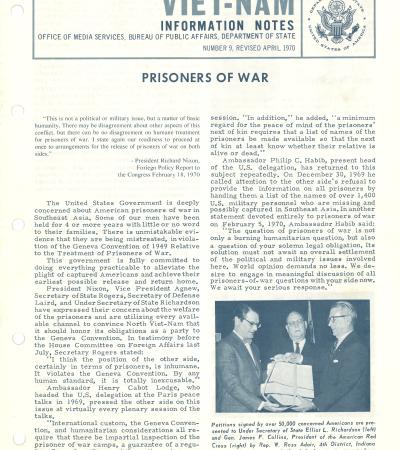
Viet-Nam Information Notes, April 1970
This document, distributed by the U.S. Department of State, provides perspective on the official government position on prisoners of war being held in Vietnam. It describes the mistreatment of POWs, including torture, lack of medical care, and isolation, all in violation of the Geneva Convention.
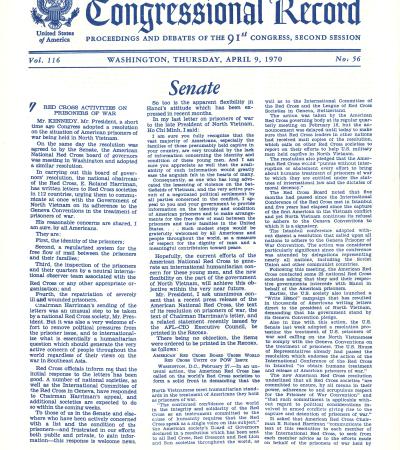
Congressional Record, April 9, 1970
The American Red Cross asked Red Cross groups around the world to pressure North Vietnam to follow the Geneva Convention and treat U.S. prisoners of war humanely. They called for identifying who the prisoners are, letting families send and receive mail, allowing neutral inspections, and releasing the sick and wounded. This effort was meant to keep politics out of the issue and focus on basic human rights for captured soldiers.
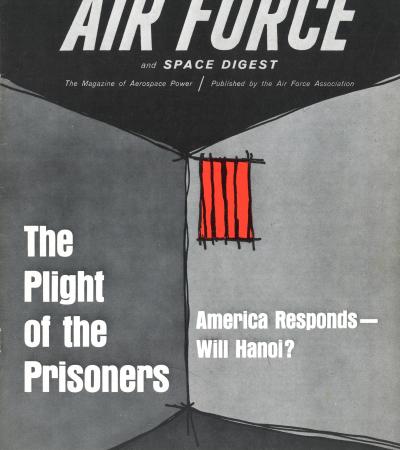
Air Force and Space Digest, June 1970
This issue of the magazine of the Air Force Association covers the growing concern for American prisoners of war (POWs) in Southeast Asia during the Vietnam War. It explains how families and military groups worked to raise awareness, organize rallies, and pressure governments for humane treatment and the release of POWs. It also provides a list of the men known by the U.S. Air Force to be prisoners of war or missing in action.
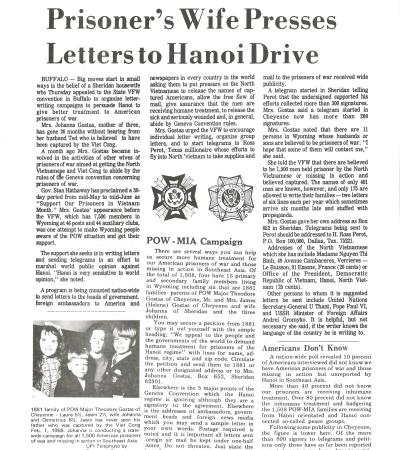
"Prisoner's Wife Presses Letter to Hanoi Drive", Casper Star-Tribune, June 6, 1970
Johanna Gostas, whose husband was captured by the Viet Cong, urged Wyoming veterans and citizens to start a letter-writing campaign demanding humane treatment for American prisoners of war. She asked people to pressure North Vietnam to follow the Geneva Convention by releasing names of prisoners, allowing mail, and caring for the sick and wounded. The campaign encouraged individuals to write letters, sign petitions, and send telegrams, stressing that this was a humanitarian issue, not a political one.
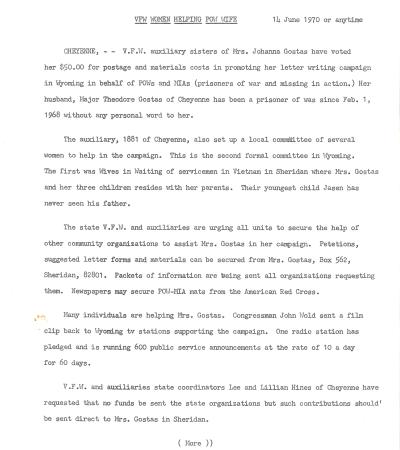
VFW Women Helping POW Wife, June 14, 1970
This press release from the Veterans of Foreign Wars Auxiliary, outlines action being taken in support of Johanna Gostas and her efforts to aid the POW/MIAs in Southeast Asia.
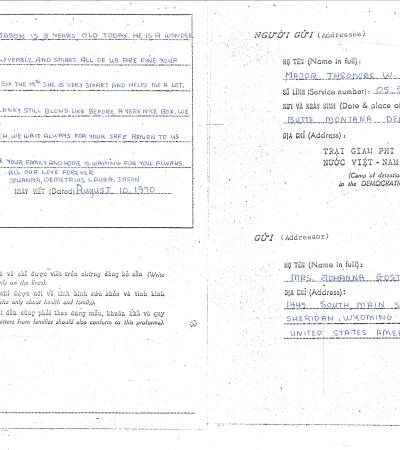
Letter from Johanna Gostas to Ted Gostas, August 10, 1970
This letter from Johanna Gostas to her husband, prisoner of war Ted Gostas, is written on the official form provided to families of POW/MIA in Vietnam.
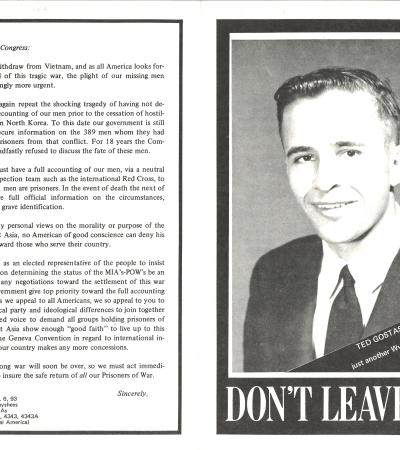
American Legion Flyer
This flyer features a photo of Major Theodore "Ted" Gostas and lists the names of other Wyoming men who are prisoners of war or missing in action in Southeast Asia. The flyer demands that these missing men be accounted for before the final withdrawal of American troops from Vietnam.
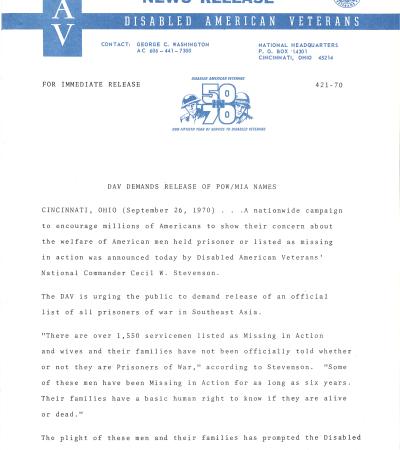
Disabled American Veterans News Release, September 26, 1970
The Disabled American Veterans (DAV) launched a nationwide campaign demanding that North Vietnam release the names of all American prisoners of war and those missing in action. To raise awareness, celebrities joined in radio and TV announcements, and the group urged millions of Americans to send letters pushing for answers.
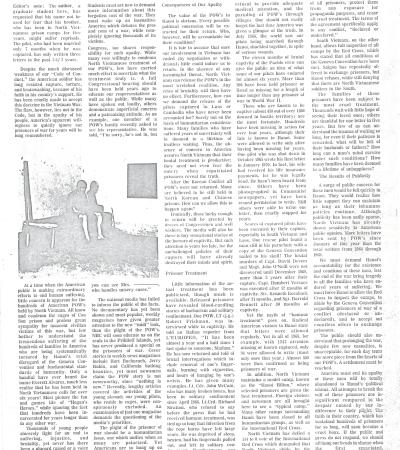
"Prisoners of War: The Forgotten Men", The Pennsylvania Daily Voice, September 15, 1970
The article, written by the brother of a prisoner of war, explains that many American POWs in Vietnam are suffering terribly while being ignored by much of the public. Families of POWs often receive little or no news, while the prisoners face cruel treatment, forced marches, and years of captivity. It calls on Americans to speak out, demand action from leaders, and support efforts like the Red Cross to ensure humane treatment and the safe return of these men.
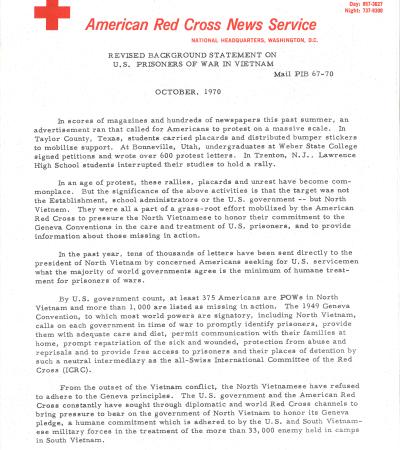
Revised Background Statement on U.S. Prisoners of War in Vietnam, October 1970
The American Red Cross organized a nationwide letter-writing campaign to pressure North Vietnam to follow the Geneva Conventions and treat U.S. prisoners of war humanely. Thousands of Americans, including students, joined in sending letters demanding that prisoners be identified, cared for, and allowed to contact their families. Although some progress was made, such as more letters from prisoners being delivered, the Red Cross pledged to keep raising the issue until North Vietnam fully respected international agreements.
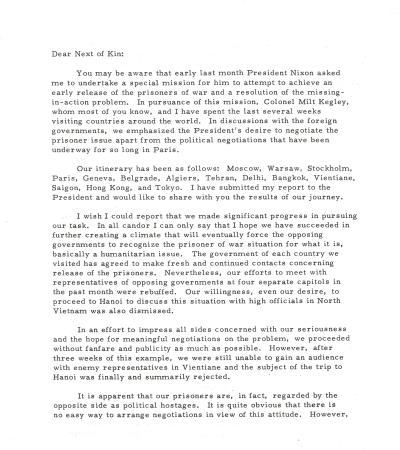
Letter from Colonel Frank Borman to Next of Kin
This letter is from Borman to the families of prisoners of war and missing in action. Borman's mission, ordered by President Nixon, was to win the release of American prisoners of war and account for the missing, but North Vietnamese officials refused to meet with him. He said that many governments around the world promised to raise the issue, but the enemy continued to treat prisoners as political hostages. Borman assured families that the U.S.
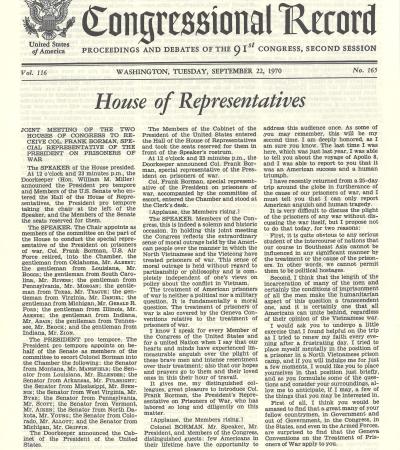
Congressional Record, September 22, 1970
Colonel Frank Borman, the U.S. President's Special Representative on Prisoners of War, spoke to a Joint Session of Congress after traveling the world to raise awareness about the harsh treatment of American prisoners of war in Vietnam. He described how prisoners suffered from starvation, isolation, and lack of medical care, while North Vietnam refused to provide a list of who was being held. Borman urged Americans and world leaders to unite, keep politics separate from humanitarian needs, and push for the Red Cross to be allowed to inspect prison camps.
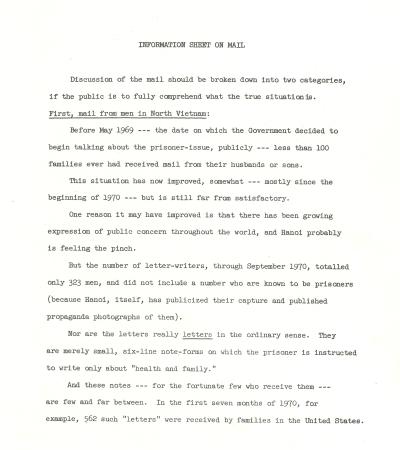
Information Sheet on Mail
This memo outlines the situation with respect to mail deliveries to and from prisoners of war. Many families have not received any letters and suspect that the letters they have written have not been delivered to the POWs.
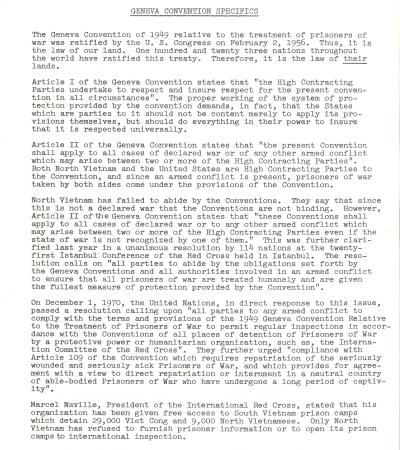
Geneva Convention Specifics
This document outlines the details of the Geneva Convention, which was ratified by 123 countries, including North Vietnam.
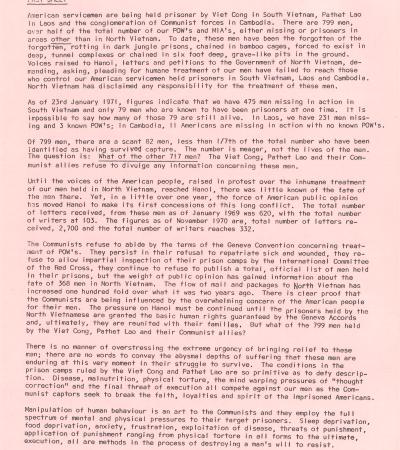
Fact Sheet
The fact sheet explains that nearly 800 American prisoners of war and missing men were being held in South Vietnam, Laos, and Cambodia, often in terrible jungle prisons where they faced disease, starvation, torture, and isolation. The document also blames the Viet Cong’s leadership, specifically Pham Hung and the Communist command, for the mistreatment of these men and demands accountability.
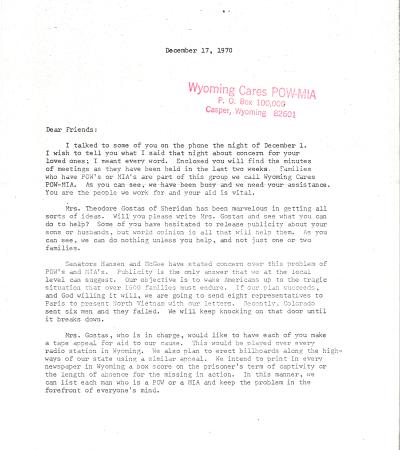
Letter from Leo R. Sanchez, December 17, 1970
In this letter, Sanchez, who is the chairman of Wyoming Cares POW-MIA, writes encouraging POW-MIA families to share information about their captive loved ones to help raise awareness. He notes that Johanna Gostas is in charge of the family efforts, which include a plan to send representatives to Paris to present North Vietnamese officials with letters from Americans asking that the country abide by the Geneva Convention in its treatment and release of prisoners.
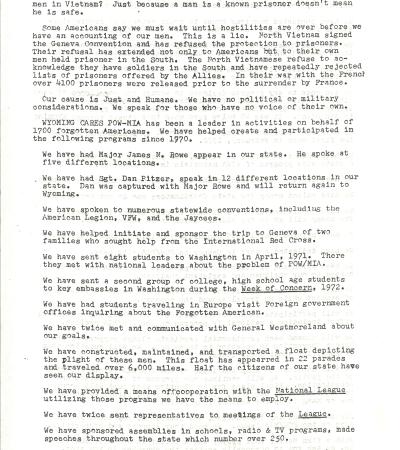
Letter from Leo R. Sanchez
In this letter, Sanchez, who is the chairman of Wyoming Cares POW-MIA, summarizes the many activities the organization has undertaken and participated in since its founding in 1970. The list he provides is extensive and demonstrates the leadership role Wyoming Cares POW-MIA has played in raising visibility of the prisoner of war and missing in action situation in Southeast Asia.
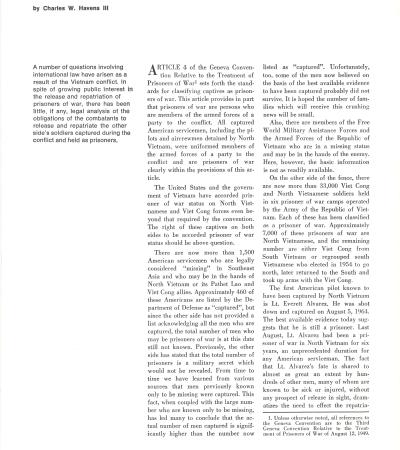
"Release and Repatriation of Vietnam Prisoners" by Charles W. Havens III, American Bar Association Journal, January 1971
The article, written from a legal perspective, explains that under the Geneva Convention, all captured soldiers in Vietnam—whether American, North Vietnamese, or Viet Cong—should be treated as prisoners of war and eventually released.
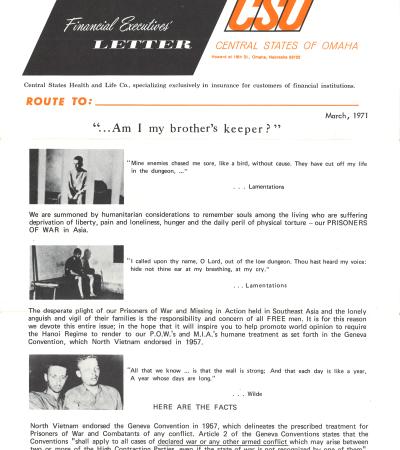
Central States Health and Life Newsletter, March 1971
This newsletter is devoted to explaining the plight of prisoners of war and missing in action in Southeast Asia. It encourages readers to join efforts to raise awareness of the situation.
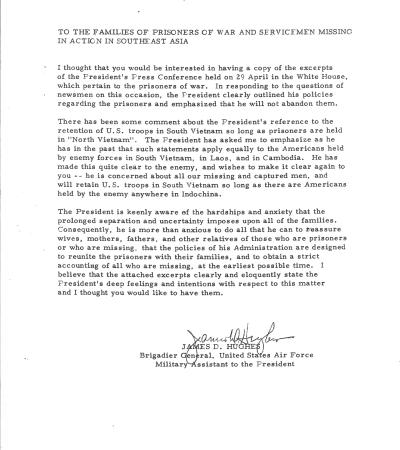
Letter from James D. Hughes to POW/MIA Families, May 10, 1971
This letter from the Military Assistant to President Nixon, informs families about Nixon's policy regarding prisoners of war and missing in action in Southeast Asia. Attached to the letter are excerpts from a press conference with Nixon and information about the president's proposal for the internment of POWs in a neutral country.
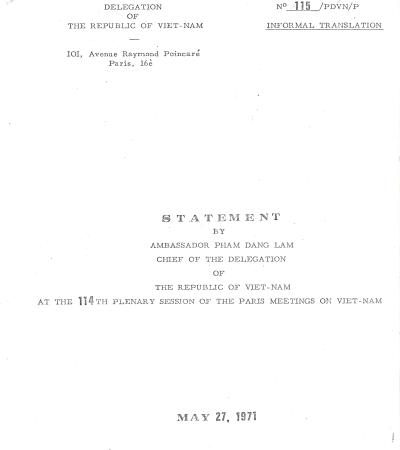
Statement by Ambassador Pham Dang Lam, May 27, 1971
This statement is from the Chief of the Delegation of the Republic of Vietnam (South Vietnam). It was delivered at the Paris Meetings on Vietnam. Lam argued that peace in Vietnam could only come if North Vietnam stopped using force to impose its communist system on South Vietnam and its neighbors.
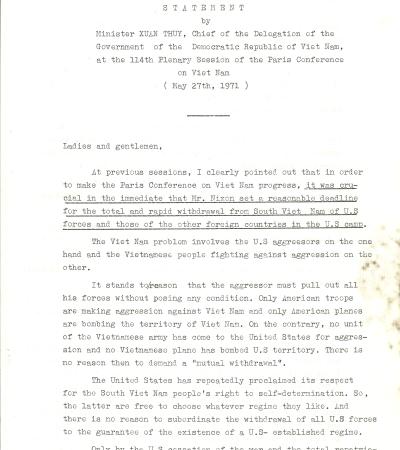
Statement by Minister Xuan Thuy, May 27, 1971
This statement is from the Chief of the Delegation of the Government of the Democratic Republic of Vietnam (North Vietnam). It was delivered at the Paris Meetings on Vietnam. Thuy argued that the U.S. must completely and quickly withdraw its forces from Vietnam without conditions.
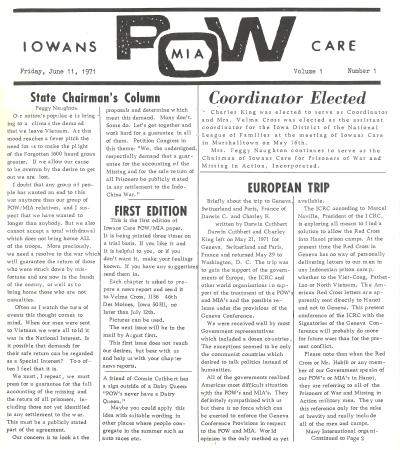
Iowans Care POW/MIA Newsletter, June 11, 1971
This newsletter is representative of the many publications from state groups set up to raise awareness of the prisoners of war and missing in action. Included in the newsletter are excerpts of a speech by George Gostas, brother of POW Ted Gostas.
Statement of Mrs. Joan M. Vinson, March 23, 1971
Vinson, whose husband U.S. Air Force Colonel Bobby Vinson had been missing in action since April of 1968, spoke before the U.S. House Foreign Relations Committee about the suffering of American prisoners held in Vietnam, Laos, and Cambodia. She criticized the U.S. government for not doing enough to bring these men home and urged leaders to take stronger action.
Statement of Mrs. Cora Weiss, March 31, 1971
Weiss' statement before the U.S. House Foreign Affairs Committee argued that U.S. policies in Vietnam were making the war worse and keeping American prisoners of war from coming home. She explained that real progress could only happen if the U.S. promised to withdraw its troops, since the Vietnamese had already offered talks under those terms. Weiss and her group worked to connect POWs with their families through letters and packages.
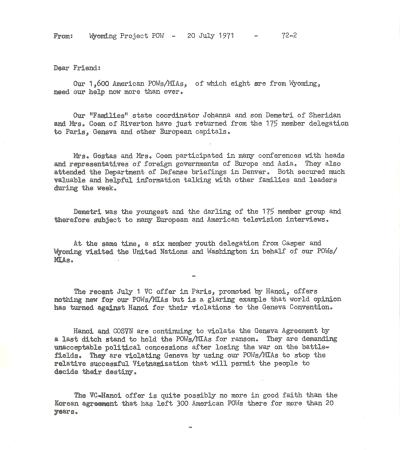
Letter from Wyoming Project POW, July 20, 1971
This letter reports that families from Wyoming, including Johanna Gostas, joined international meetings to push for better treatment and release of American prisoners of war and missing men. They criticized North Vietnam for breaking the Geneva Convention by holding prisoners as political bargaining tools instead of treating them fairly. Citizens were urged to keep the campaign alive by contacting leaders, spreading awareness and showing that public opinion strongly supports bringing the prisoners home.
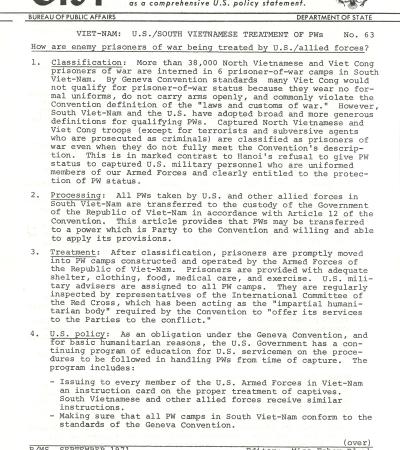
Viet-Nam: U.S./South Vietnamese Treatment of PWs, September 1971
This memo, prepared by the U.S. Department on State, briefly summarizes how North Vietnamese and Viet Cong prisoners are being treated by U.S. and South Vietnamese forces. It notes that the U.S. and South Vietnamese run prisoner of war camps abide by the Geneva Convention. This is in stark contrast to the treatment American POWs receive.
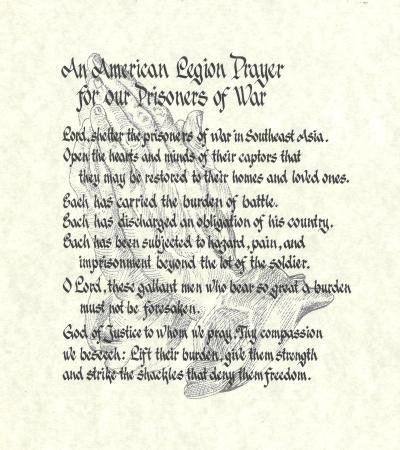
An American Legion Prayer
This prayer for prisoners of war was distributed by the American Legion.
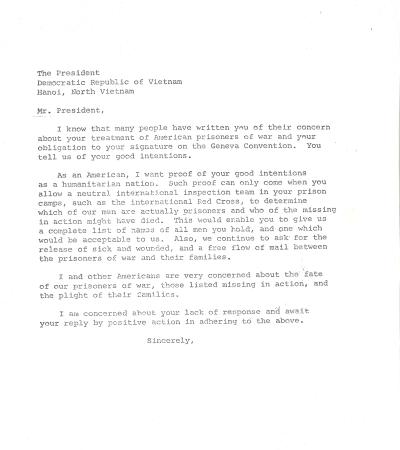
Form Letter to the President of the Democratic Republic of Vietnam
This form letter was distributed to Americans, who were urged to write the leader of North Vietnam. The letter urged compliance with the Geneva Convention and cooperation with the International Red Cross.
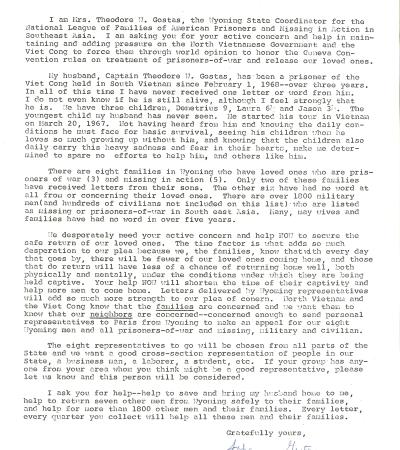
Letter from Johanna Gostas
This letter from Johanna Gostas asks for support to put pressure on the North Vietnamese government and the Viet Cong to follow international rules and release American prisoners of war. By the time this letter was written, her husband, Captain Theodore Gostas, had been missing for over three years without any proof of life.
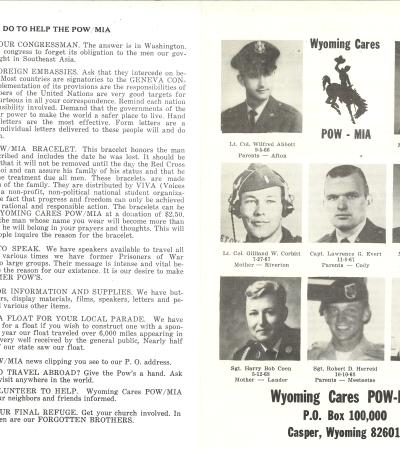
Wyoming Cares POW-MIA Flyer
This flyer features pictures of the prisoners of war and missing in action with relatives in Wyoming. It includes advice to the public as to what they can do the help, and information about the conditions under which the POWs suffer.
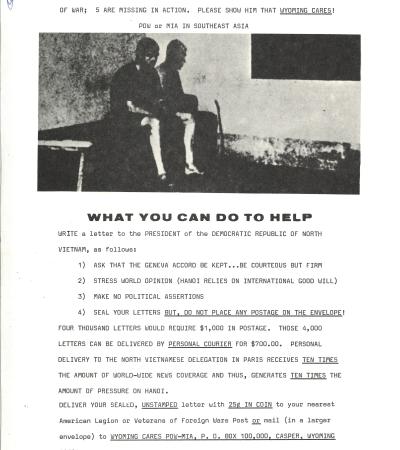
Wyoming Cares POW-MIA Poster
This poster encourages Americans to write letters to the President of North Vietnam urging him to abide by the Geneva Convention which mandates humane treatment and release of prisoners of war.
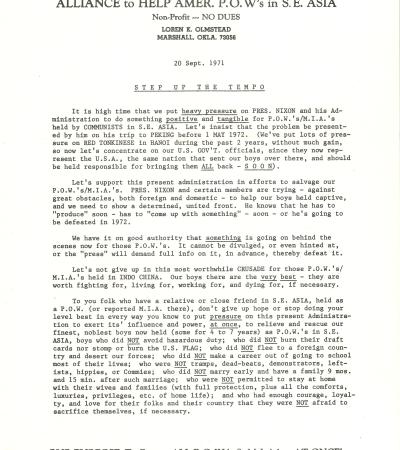
Alliance to Help American POWs in S.E. Asia Newsletter
This newsletter urges Americans to pressure President Nixon and the government to take stronger action to rescue prisoners of war and those missing in action in Southeast Asia. The writer stresses that many U.S. servicemen have been held for years under harsh conditions, and argues that far more may be missing than the government admits. Families and citizens are called on to speak out, contact politicians, and show public support to ensure these soldiers are not forgotten.
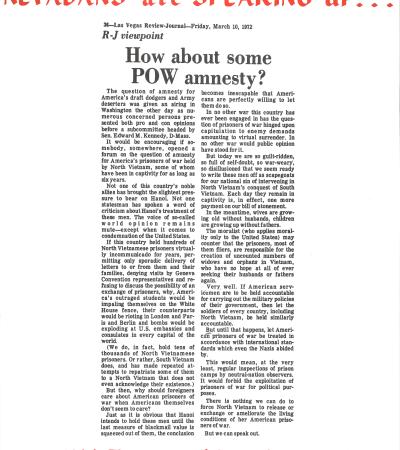
"How About Some POW Amnesty", Las Vegas Review-Journal, March 10, 1972
The article argues that while Americans debate forgiving draft dodgers and deserters, little is being done to demand better treatment or release of U.S. prisoners of war in North Vietnam. It criticizes the lack of global outrage, noting that families of prisoners suffer as their loved ones remain in captivity under unspeakable conditions. The piece calls for international inspections and accountability, urging Americans to speak out.
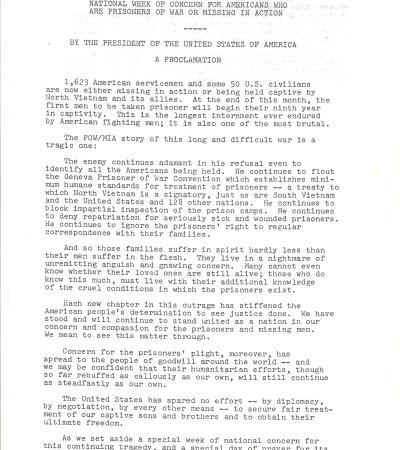
White House Press Release, March 10, 1972
President Nixon declared March 26–April 1, 1972, as a National Week of Concern for American POWs and MIAs, with March 26 as a National Day of Prayer. He explained that more than 1,600 Americans were missing or captured in Vietnam, many suffering brutal conditions while their families endured anguish and uncertainty. The proclamation called on Americans to unite in prayer, compassion, and action to support the prisoners and their loved ones until they could safely return home.
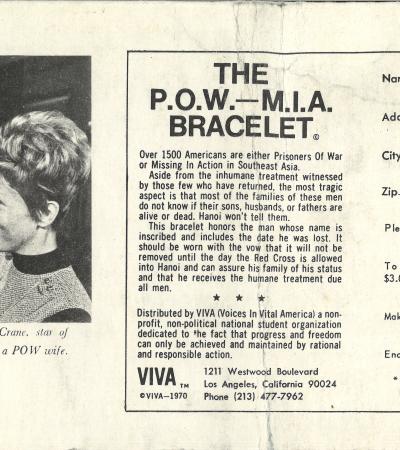
POW-MIA Bracelet Order Form
A campaign to remember the 1500 American Prisoners of War (POW) and Missing in Action (MIA) in Vietnam included the sale of bracelets honoring the men who had disappeared.
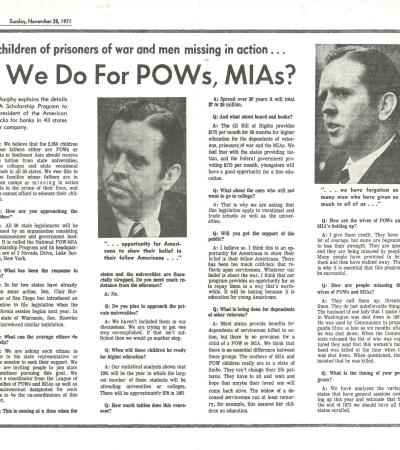
"What Can We Do For POWs, MIAs?", San Diego Union, November 28, 1971
This article covers an interview with J. Kevin Murphy, who answers questions about a proposal to provide children of prisoners of war and missing in action with free tuition to state colleges, universities and vocational schools.
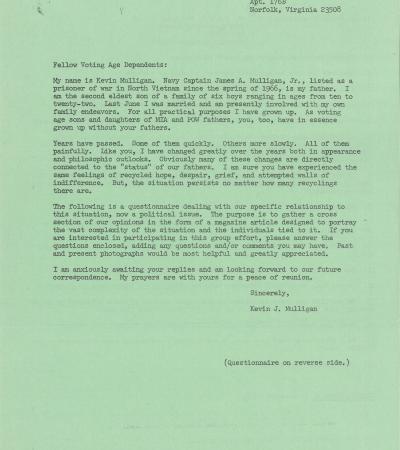
Letter from Kevin J. Mulligan
This letter, from the son of a prisoner of war, was sent out to other young adult children of prisoners of war or missing in action. It includes a survey, with the goal of gathering opinions for a magazine article.
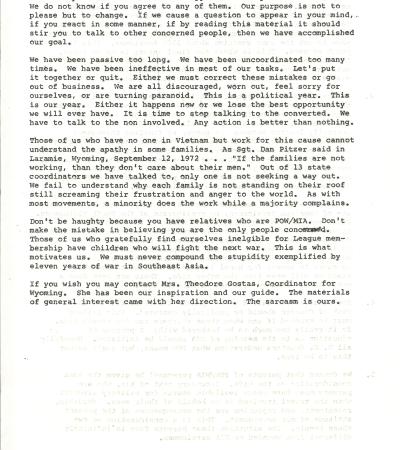
Wyoming Cares POW-MIA Suggestions
This document provides insight into the challenges POW-MIA families faced as they spent years trying to raise awareness of their prisoner of war or missing in action family member.
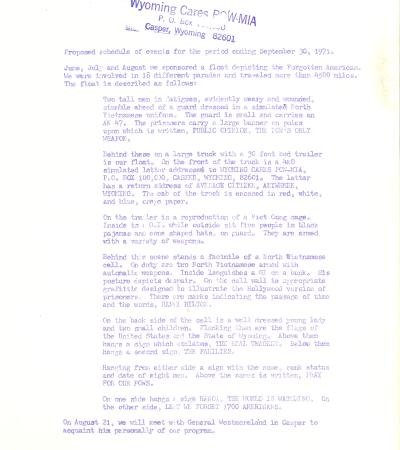
Wyoming Cares POW-MIA Parade Float
This document describes in detail the parade float created in Wyoming to depict the plight of American prisoners of war in Southeast Asia. The float was involved in 18 different parades and traveled more than 4500 miles. It was a graphic and effective way of raising awareness about the prisoners of war and missing in action.
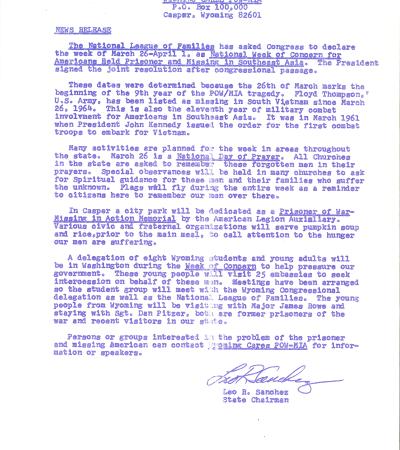
Wyoming Cares POW-MIA News Release
This news release announces a national week of concern for Americans held prisoner and missing in Southeast Asia. Among the activities planned are dedication of a city park in Casper. In addition, a delegation of eight Wyoming students planned to travel to Washington D.C. to pressure the government to take action.
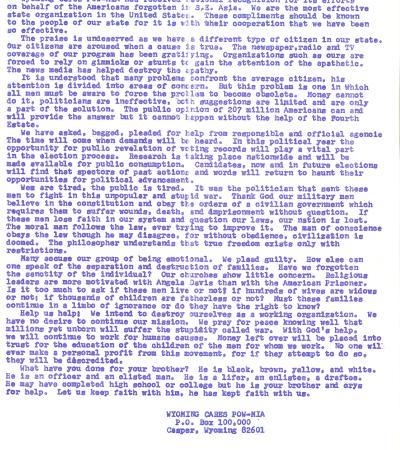
Wyoming Cares POW-MIA Statement of Philosophy
The group Wyoming Cares POW-MIA works to remind people about American prisoners of war and those missing in action, and they believe citizens must stay involved to keep attention on this issue. They stress that families deserve to know the truth about their loved ones and that ignoring the problem is unacceptable. The organization promises to keep fighting for peace, truth, and support for families.
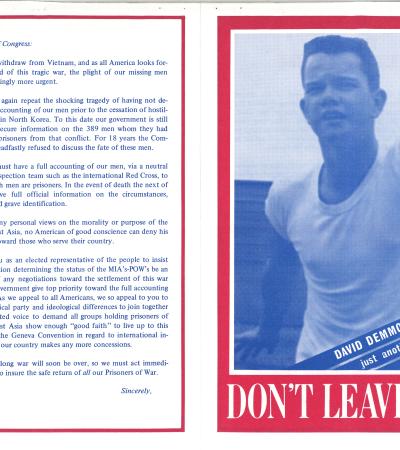
Don't Leave Us Flyer
This flyer features a picture of POW David Demmon and a form letter to be sent to members of the U.S. Congress. It also includes contact information for the more than 30 organizations across the U.S. focused on bringing the prisoners of war and those missing in action home.
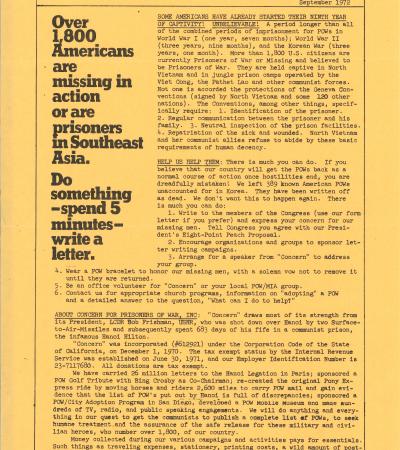
Concern For Prisoners of War
This flyer from the Concern for Prisoners of War organization outlines action Americans can take in support of prisoners of war. The organization's leadership includes two former prisoners of war.
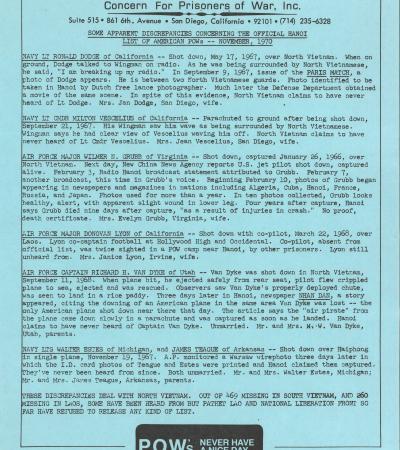
List of American POWs, November 1970
This bulletin from the Concern for Prisoners of War organization publicizes some discrepancies concerning the official Hanoi list of American POWs. It names specific individuals known to have been shot down, but whose location remain unknown or unacknowledged by the North Vietnamese.
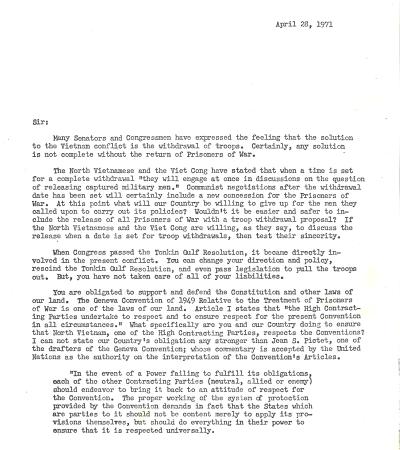
Letter from Lieutenant Robert F. Frishman, April 28, 1971
Frishman, who had been a prisoner of war in North Vietnam, addresses this letter to all members of the U.S. Congress. He urged them to make sure that American POWs were included in any Vietnam troop withdrawal plans. He explained that the U.S. had a legal and moral duty under the Geneva Convention to protect prisoners and push North Vietnam to release them.
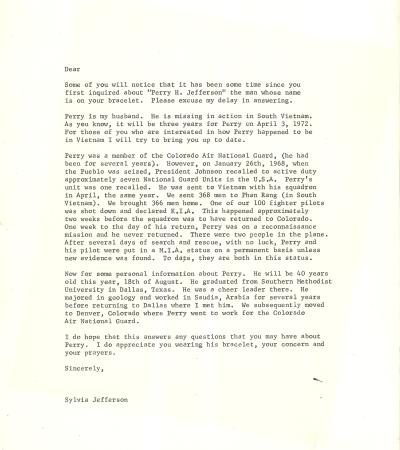
Form Letter from Sylvia Jefferson
This letter, written by the wife of missing in action National Guardsman Perry Jefferson, was sent to Americans who had purchased a POW/MIA bracelet with Jefferson's name on it.
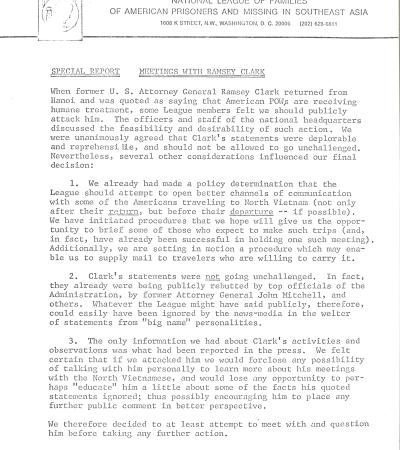
Special Report - Meetings With Ramsey Clark
This report was issued by the National League of Families of American Prisoners and Missing in Southeast Asia. It details comments made by U.S. Attorney General Ramsey Clark after his meeting with American prisoners of war being held in Hanoi.
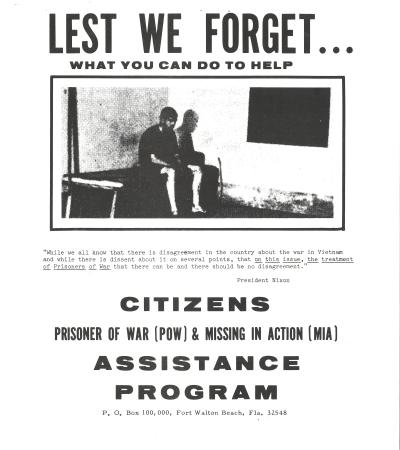
Lest We Forget Bulletin
This document was prepared by the Florida Chapter of the National League of Families of American Prisoners in Southeast Asia. It provides background information on POWs as well as an extensive list of actions individuals are encouraged to take to raise awareness of POWs, including letter writing. Sample form letters are provided.
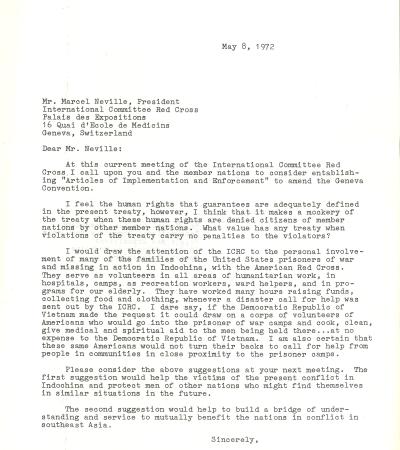
Letter to Marcel Neville, May 8, 1972
This letter was sent to Neville, the president of the International Committee Red Cross, urging him to amend the Geneva Convention with articles of implementation and enforcement in hopes that the North Vietnamese could be compelled to respect the human rights of their American prisoners of war.
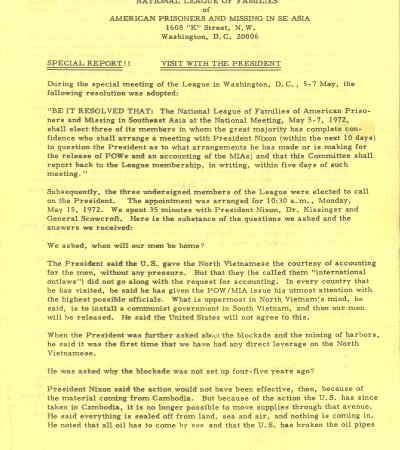
Special Report - Visit With The President
This report was issued by the National League of Families of American Prisoners and Missing in Southeast Asia. It details comments made by President Richard Nixon during a meeting with three representatives of the group.
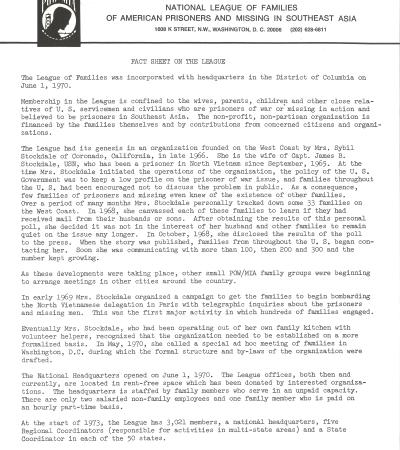
Fact Sheet on the National League of Families of American Prisoners and Missing in Southeast Asia
This fact sheet outlines the history of the National League of Families of American Prisoners and Missing in Southeast Asia. The organization was founded by Sybil Stockdale, wife of POW James B. Stockdale. It became the largest organization working on behalf of POW/MIA servicemen and their families.
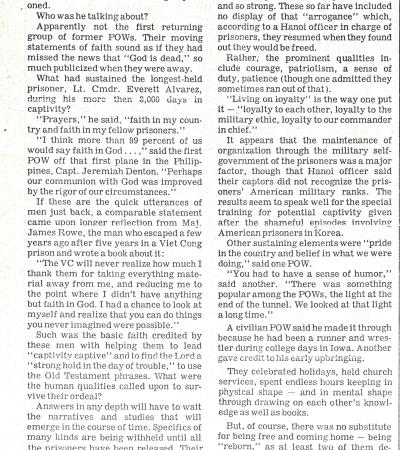
"The Faith of the POWs", February 22, 1973
The article describes how many American prisoners of war in Vietnam survived years of captivity by relying on faith in God, loyalty to each other, and pride in their country. Former POWs shared that prayer, humor, discipline, and self-organization helped them stay strong and hopeful during terrible conditions.
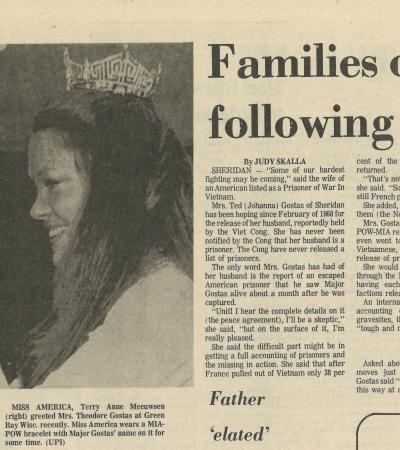
"Families of Prisoners Following Peace Moves" by Judy Skalla, Casper Star-Tribune, October 27, 1972
In this article, Johanna Gostas shared her worries about peace talks between the U.S. and the North Vietnamese, saying she won’t believe in progress until there is proof of prisoners like her husband being released. She explained that many families are desperate for accurate information about their loved ones and fear that politics and negotiation details could delay their return.
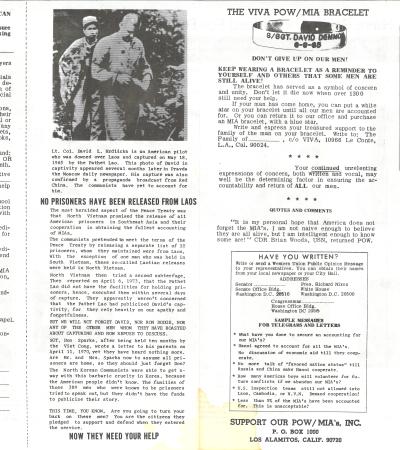
Support Our POW/MIAs Flyer
This flyer urges readers to continue to remember the prisoners of war and missing in action in Southeast Asia. It notes that no prisoners have been released from Laos, and includes photos of American men who have not been accounted for by North Vietnam in prisoner lists that have been released.
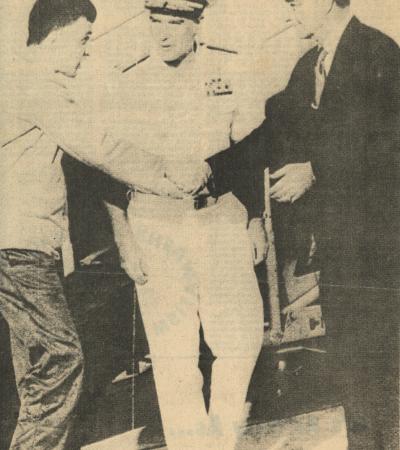
Photo of Major Ted Gostas
Major Ted Gostas (left) arrives at Clark Air Force base in the Phillippines after his release from a Viet Cong prison camp on March 16, 1973. He is greeted by American Ambassador Henry A. Byroade (right). Admiral Noel Gayler (middle) looks on. Gostas had been captured on February 1, 1968 and spent more than 4 years in captivity as a prisoner of war.
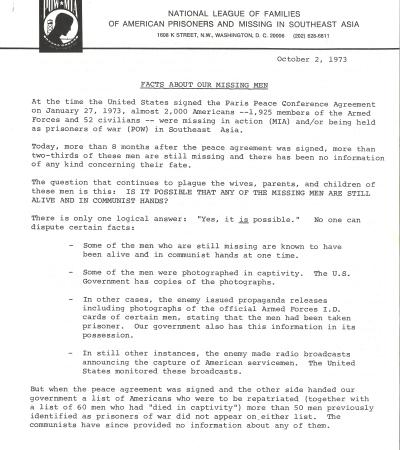
Facts About Our Missing Men, October 2, 1973
This press release from the National League of Families of American Prisoners and Missing in Southeast Asia notes that despite the signing of the Paris Peace Conference Agreement at the beginning of 1973, nearly 2,000 Americans remain missing or are still being held as POWs in Southeast Asia. The group demands answers from the North Vietnamese and their allies and asks for the support of the American government in getting those answers.
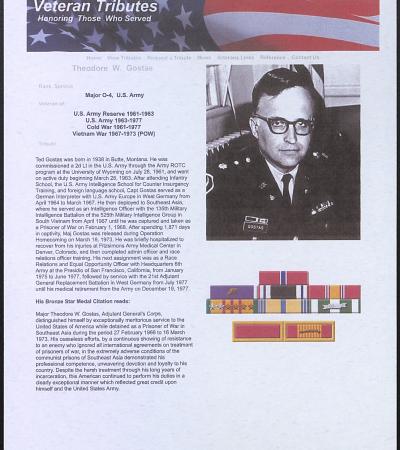
Veteran Tribute for Theodore W. Gostas
This tribute outlines Ted Gostas' military career and provides the citation associated with his U.S. Army Bronze Star medal.